
I've got a filing cabinet drawer full of chiropractor receipts from the last fifteen years and a neck that still locks up on me after a long day working under a lift gate. So when a customer at the shop mentioned he'd cut back on his biweekly adjustments and started using a cervical traction device at home instead, I figured I owed it to my own neck to find out if that trade actually made sense. I bought the Lumia Wellness Cervical Orthotic Traction Block, and I kept my chiropractor on speed dial the whole time I tested it. Here's the honest comparison, not a sales pitch for either side.
The short answer: a home traction device is not a replacement for a chiropractor, and anyone telling you otherwise is selling you something. What it is, is a cheap, always-available tool that handles the day-to-day tightness so you're not booking, and paying for, an adjustment every time your neck feels off after a rough shift. Chiropractors do things a foam block never will, hands-on diagnosis, targeted adjustments, catching something that's actually wrong before it turns into a bigger problem. I still see mine. I just see him a lot less often now, and I use the traction block on the nights in between when my neck's tight but nothing feels genuinely wrong.
I want to be straight with you before we go further. I'm not a doctor, a chiropractor, or a physical therapist. I'm a mechanic who's spent three decades with his neck cranked at bad angles under dashboards and lift gates, and I've been getting adjusted on and off since my wife was still around to remind me to book the appointment. If you've got numbness running down your arm, dizziness, or a neck injury from an accident, skip everything below and get seen by a real professional first. This article is about everyday stiffness, not diagnosing anything serious, and it shouldn't be treated as medical advice.
What actually pushed me to look into this wasn't pain, it was scheduling. My chiropractor's office is thirty minutes from the shop, and between the drive there, the wait, and the drive back, a fifteen-minute adjustment turns into most of an afternoon I don't always have to give up. There were stretches where I'd let a tight neck ride for two weeks just because I couldn't get in, and by the time I finally sat in that chair I was in worse shape than I needed to be. That gap between when my neck locks up and when I can actually get seen is exactly where a home device is supposed to earn its keep, so that's what I put it up against.
| Neck Traction Device | Chiropractor Visits for Stiff Neck Relief | |
|---|---|---|
| Approach | Lumia Wellness Cervical Traction Block (at-home) | In-Office Chiropractor Adjustments |
| Cost per use | One-time cost around today's price, then free forever | Copay or out-of-pocket fee every single visit |
| Time commitment | 10 to 15 minutes, whenever you want it | Drive time plus a scheduled appointment, usually 20 to 30 minutes |
| Professional diagnosis | None, it cannot tell you what is actually wrong | Yes, hands-on assessment and imaging referral if needed |
| Hands-on manual adjustment | No, gentle passive stretch only | Yes, targeted adjustment by a trained professional |
| Availability | Anytime, including 9pm when your neck locks up | Only during office hours, and only if there is an opening |
| Best for | Daily maintenance and end-of-shift tightness | Diagnosing pain, misalignment, or an injury |
| Learning curve | Low, lie down and adjust the angle | None on your part, the chiropractor does the work |
That table looks lopsided toward the block until you get to the two rows in the middle, diagnosis and hands-on adjustment. Those aren't small things. A block can loosen tight muscles and gently stretch out a compressed neck, but it has no idea if you've got a pinched nerve, a bulging disc, or just garden-variety tightness from bad posture. That's exactly why I didn't cancel my chiropractor when I started using the block. I just stopped needing him every two weeks.
Where the Traction Device Wins
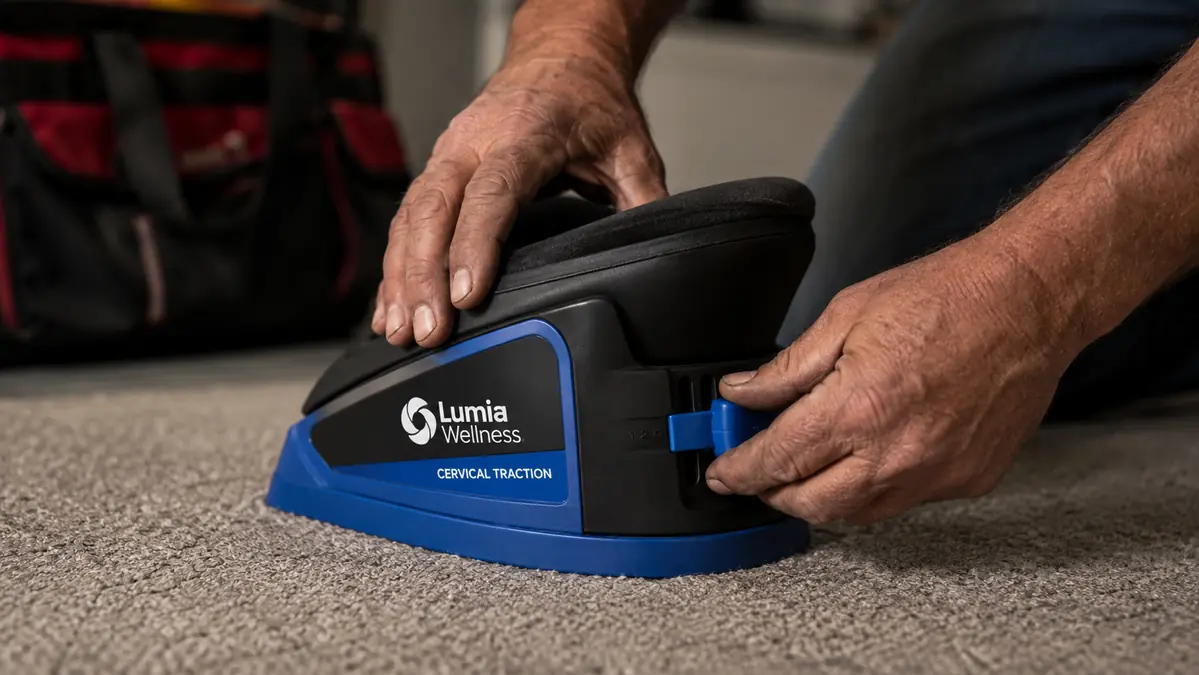
The biggest win for the traction block is simple, it's there. My neck doesn't lock up on a schedule that matches chiropractor office hours. It happens at 9pm after I've spent an afternoon with my head cranked sideways reaching into an engine bay, or at 6am before my shift when I slept wrong on the couch. I lie down on the rug, set the block under my neck at the angle that works for me, and fifteen minutes later the tightness that would've had me calling for an appointment has eased up enough that I can get through my day. I keep it next to the couch now, same spot where I used to keep a heating pad, and Duke and Nika have both learned to step over me when I'm on the floor with it.
The other win is what it saves me. I used to book an adjustment almost every time my neck got tight, because that was the only tool I had. Between the drive, the wait, and the fee, that adds up fast when you're doing it every couple weeks for basic stiffness that isn't actually a problem, just wear and tear from the job. Since I started using the block on the nights my neck feels tight but nothing's actually wrong, I've cut my chiropractor visits down to about once a month instead of twice. I'm not skipping care I need. I'm just not paying for maintenance I can handle myself with a piece of firm foam that lives under my couch.
It's also just simpler to be consistent with. I know myself well enough to admit I won't always follow through on scheduling something that requires calling ahead, especially on a week when the shop's slammed and I'm picking up extra hours. The block doesn't require that kind of planning. It sits by the couch, and using it becomes as automatic as brushing my teeth once you build it into your evening. That consistency is probably doing more for my neck day to day than any single adjustment ever did, simply because I actually do it.
Where Chiropractor Visits Win
Here's what I'd never tell a guy to skip. A chiropractor puts hands on you and can tell the difference between a stiff neck from bad posture and something that needs real attention, a misalignment, a disc issue, a nerve getting pinched somewhere. The traction block can't do any of that. It stretches your neck out gently and that's the whole trick. It has no idea what it's stretching or whether stretching is even the right move for what's going on. I found that out the hard way a few years back when I had a stretch of tingling running down my left arm and just kept doing stretches at home instead of getting it looked at. Turned out to be a disc issue that needed real treatment, not a home gadget.
Chiropractors also adjust the actual joints, not just the soft tissue around them. A traction device pulls gently on your cervical spine in a straight line. A chiropractor can target one specific vertebra that isn't moving right and address that exact spot. Those are two different jobs, and no home tool does the second one. If you've had a car accident, a fall, a sports injury, or pain that's getting worse instead of better, that's a chiropractor's job, not a foam block's. I still see mine once a month even on weeks I feel fine, because catching something small before it turns into a big problem is worth more than what I'd save skipping the visit.
There's also accountability built into a chiropractor visit that a home device just doesn't have. He asks me how my neck's actually been, notices if I'm favoring one side, and follows up on things I mentioned last visit that I'd probably have forgotten about myself. A block doesn't ask you any questions. It just sits there and does the same gentle stretch whether your neck is genuinely improving or quietly getting worse underneath the surface. That kind of ongoing check-in is worth something, especially once you're past fifty and your body doesn't always tell you the truth right away.
The tool that handles the tightness between chiropractor visits
I keep the Lumia Wellness Cervical Traction Block by the couch for the nights my neck's tight after a long shift but nothing feels actually wrong. Firm support, adjustable angle, and it's paid for itself in adjustments I didn't need to book.
Amazon Check Today's Price on Amazon →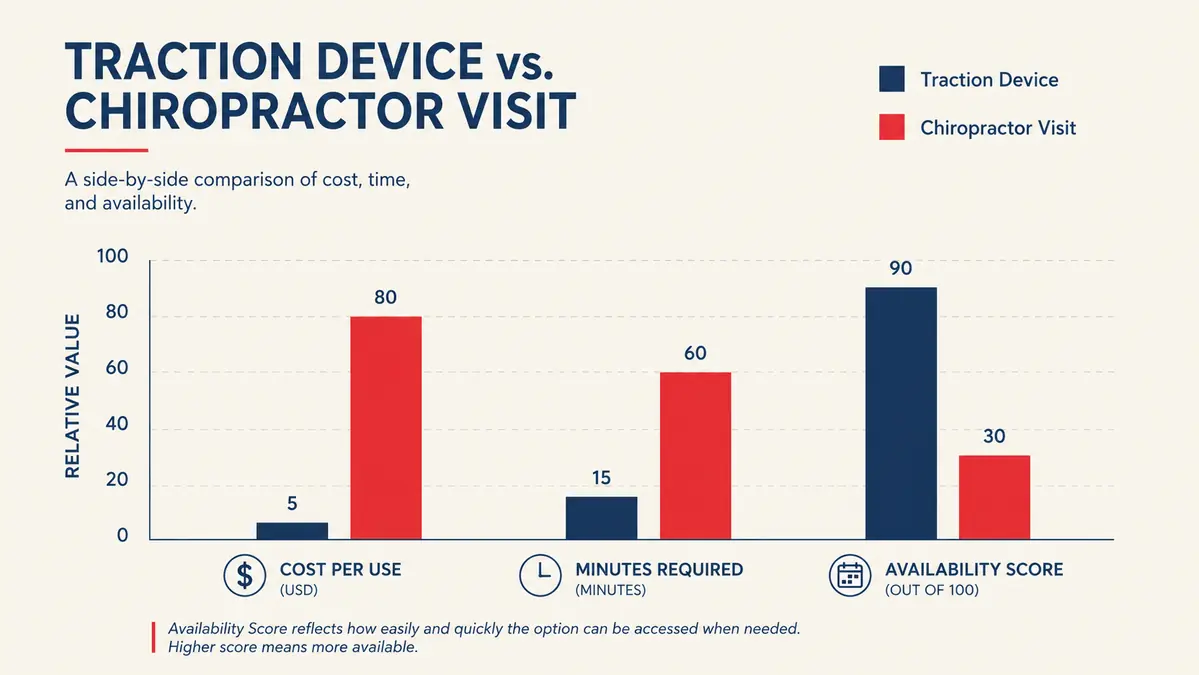
How I Actually Split This Now
My routine now is pretty simple. I use the traction block three or four nights a week, usually after a shift where I've had my neck cranked at some ugly angle for hours. I still see my chiropractor once a month for an actual adjustment, not because I'm in pain most of the time, but because he catches things I can't feel yet on my own. If a stretch on the block ever made things worse instead of better, or if I got any numbness, tingling, or pain that didn't ease up after a day or two, I'd be on the phone booking an appointment instead of reaching for the block again. That's the line I don't cross. The block handles maintenance. He handles anything that isn't just maintenance.

Who Should Buy Which
If your neck gets tight from work, bad sleep, or sitting at a desk all day, and you don't have any numbness, sharp pain, or injury behind it, the traction block is a smart first move. It's cheap, it works at home on your schedule, and it'll probably cut down how often you feel like you need to see anyone at all. If you've had an accident, you've got pain radiating down an arm, or something just feels wrong instead of tight, skip the home gadget and get in front of a chiropractor or a doctor first. Get a real diagnosis before you start stretching anything on your own, no matter how good the reviews on the block look.
I don't think this is really an either-or decision, no matter how the headline reads. I use both, and honestly the block is what keeps my chiropractor visits from turning into a twice-a-month bill for garden-variety stiffness. It's not replacing what he does. It's handling the stuff that doesn't need him. If you're the kind of guy who's been putting off both because appointments are a hassle and your neck's just gotten used to being tight, start with the block, pay attention to how your body responds, and don't be stubborn about booking a real visit if something feels off instead of just tired.
Give your neck a cheaper option before the next appointment
The Lumia Wellness Cervical Traction Block won't replace a real chiropractor, but it'll handle the nights your neck's tight and nothing's actually wrong. Firm, adjustable, and small enough to keep by the couch.
Amazon Check Today's Price on Amazon →