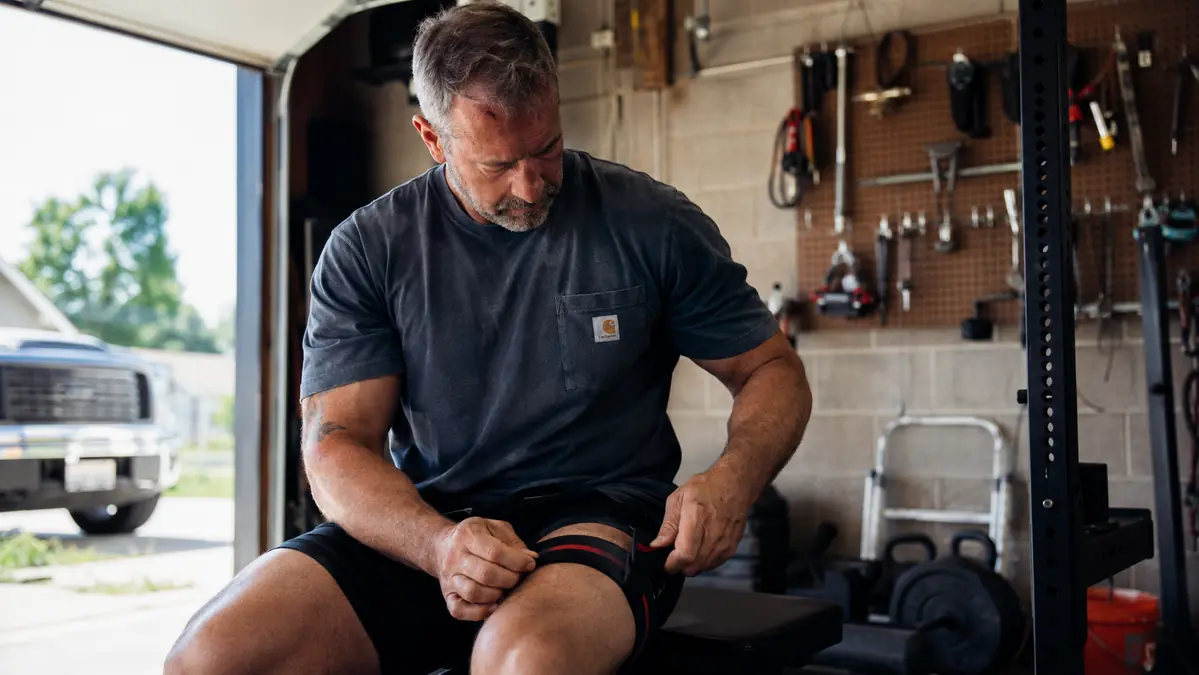
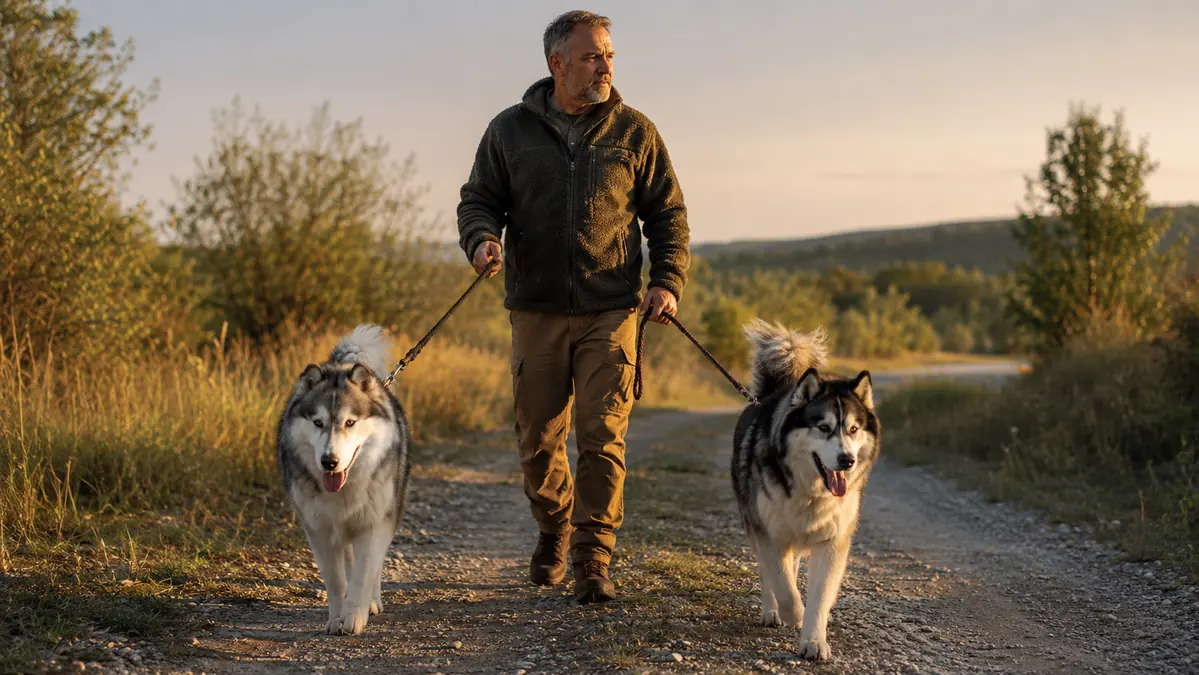
My left knee has been talking to me since 2019, the year I tore something in there wrestling a transmission off a lift that wasn't seated right. The doc in town told me arthroscopic surgery might buy me five good years before I'd need a scope again anyway, and at 54 with a mortgage, a full shop schedule, and two Siberian huskies named Diesel and Nova who need three miles a day whether I feel like it or not, I wasn't interested in six weeks on crutches. So when a guy at the counter mentioned BFR BANDS Pro, occlusion bands that are supposed to let you build muscle without loading the joint with heavy iron, I figured it was worth six months of my time to find out if it actually worked or if it was going to end up next to the vibration plate I bought in 2022 and used four times.
I bought the set in early January 2026, four bands total, two narrower ones for the arms and two wider ones for the legs, along with the little pump gauge they throw in for reference. What follows is what happened over six months of using them two to three times a week, not a marketing pitch. I still have a bad knee. I did not turn into a bodybuilder. But something did change, and I want to walk through exactly what and why before you spend your money.
The Quick Verdict
A legitimately different tool, not a gimmick, but it demands you read the instructions and respect the pressure gauge, not just strap in and go.
Amazon Check Today's Price →Six months of testing on a bad knee, here's what I'd actually buy again
If you're dealing with a joint that won't tolerate heavy loading anymore but you still want to keep the muscle around it strong, this is the one piece of gear from my last two years of trial and error that I'd replace without hesitation.
Amazon Check Today's Price on Amazon →How I've Used It
My protocol was simple because I don't have time for complicated. Twice a week, sometimes three if the shop was slow, I'd wrap the BFR BANDS Pro leg straps above the knee on the good leg first, then the bad one, and run a short circuit of bodyweight squats to a bench, standing calf raises, and light leg extensions with a five-pound ankle weight I already had in the garage. Fifteen to thirty reps a set, four sets, maybe forty-five seconds rest between. The whole thing takes fifteen minutes if I'm not stopping to answer the shop phone.
Twelve-hour days under a lift leave my lower back and forearms wrecked before my legs ever get a turn, so I learned fast that BFR sessions work best either first thing in the morning before the shop opens or on my two weekly days off. Trying to squeeze a session in after a double shift on brakes and an alignment just meant I skipped it, and skipping it is where these things go to die in a garage corner.
The idea behind blood flow restriction, if you haven't run into it before, is that you cinch a band around the top of the limb tight enough to slow venous return without cutting off arterial flow, which tricks the muscle into working harder and fatiguing faster on light loads than it would otherwise. I'm not a physical therapist and I'm not going to pretend I understood the science before I tried it. What I understood was that my knee couldn't handle a barbell squat anymore, and I needed some way to keep the muscle around that joint from wasting away, because a weak quad on a bad knee is a worse problem than the knee itself.
I logged sessions in a cheap notebook I keep on the workbench next to my oil change logs, mostly out of habit from tracking torque specs for thirty years. Reps, band gauge number, how the knee felt walking the dogs the next morning. That log is the only reason I trust what I'm about to tell you, because six months blurs together fast when you're running a shop.
What's Actually in the Box
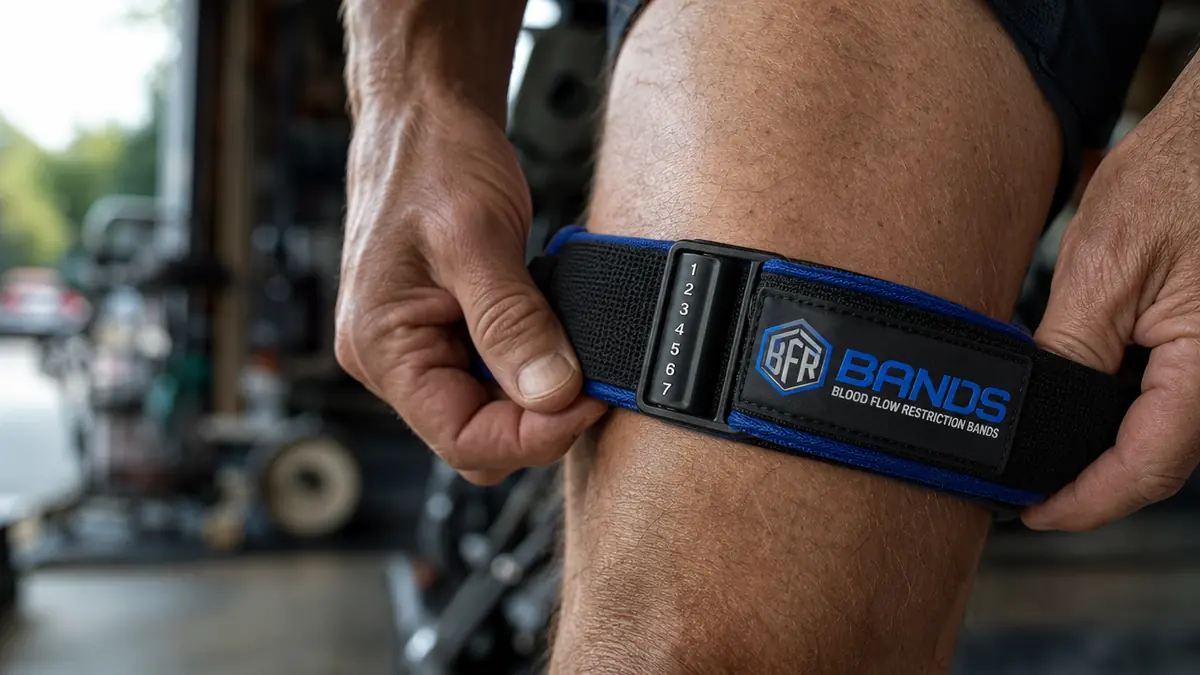
You get four elastic nylon BFR BANDS Pro straps with quick-release buckles, a narrower pair for the upper arms and a wider pair for the upper legs, plus a small companion gauge card that helps you land on a consistent number instead of guessing at tightness by feel every time. That gauge matters more than it sounds like it would. The first two weeks I was cinching the leg bands too tight out of a mechanic's instinct to make sure something is secure, and my foot started going numb by the second set. Once I backed off to the recommended pressure range and used the numbered marks on the strap to hit the same tightness every session, that problem went away completely.
Sizing is on you to get right, and BFR BANDS doesn't hold your hand much here. You measure your own thigh and upper arm circumference and match it to their chart before you order, and if you guess wrong the strap either won't cinch down enough to do anything useful or it digs in painfully before it hits a workable pressure. I measured twice with a cloth tailor's tape before I ordered, and I'd tell anyone else to do the same instead of eyeballing it the way I eyeball a bolt size.
The quick-release buckle is the feature I'd flag as genuinely well thought out. When you're mid-set and your leg starts feeling wrong, you don't want to be fumbling with a knot or a velcro strip that's lost its grip. One pull and the band is off. I tested that on purpose in week three, cranked a band tighter than I should have just to see how fast I could get out of it, and it released in under two seconds. For anyone working around a joint injury, that's not a small detail, that's the difference between a tool you trust and one you're nervous around.
Six Months In: What Changed
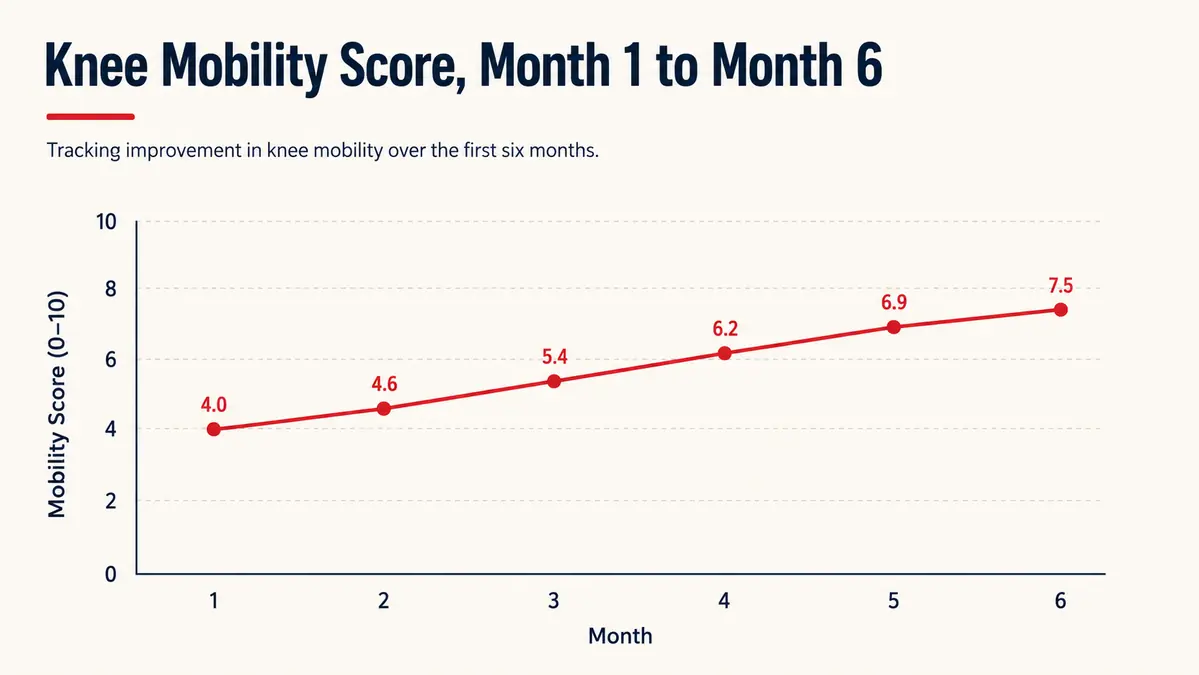
By month two I noticed the knee felt less stiff getting out of the truck in the morning, which had been my worst symptom for three years running. By month four, walking the dogs on our usual gravel loop, a route I know is exactly 2.8 miles because I've mapped it a dozen times, stopped requiring a stop halfway to let the knee settle. That was the change that actually mattered to me, not some number on a chart but being able to keep pace with Diesel and Nova without falling behind.
I also put a tape measure on my thigh circumference in January and again in June, because after 2019 I'd watched that leg visibly shrink compared to the right one, the kind of muscle wasting that happens when you unconsciously favor a joint for years. It came back up about three quarters of an inch, which isn't dramatic, but it's the first time in six years that leg has grown instead of shrunk. I credit the consistency more than any single mechanism, three times a week for six months is more attention than that knee had gotten since the injury.
There was a side benefit I didn't expect. Somewhere around month three, holding a breaker bar on a stubborn lug nut stopped aggravating my forearm the way it used to after a long day. I can't prove the bands caused that specifically since I wasn't running arm sessions as consistently as leg sessions, but the general uptick in muscular endurance across sessions seemed to carry over into grip and forearm work at the shop, which I wasn't expecting when I bought these purely for the knee.
What didn't change: the knee still aches after a full twelve-hour day under a lift, especially in cold weather, and it still clicks going down stairs. This isn't a cure for a torn meniscus. It's a tool that let me keep training around one without making it worse, and after two failed attempts at other recovery gadgets over the years, that alone earned my respect.
The Tradeoffs Nobody Mentions
The instructions that come in the box are thin, basically a folded card with a diagram and a suggested pressure range. If you've never done occlusion training before, you'll want to spend twenty minutes watching a reputable video on proper strap placement and pressure before your first session, because doing it wrong isn't just ineffective, it can be genuinely uncomfortable or worse if you cinch too tight for too long. I'd have paid a couple extra dollars for a more thorough guide in the box.
The strap material also shows wear faster than I expected. Mine started to lose a little elasticity in the wider leg bands around month five, noticeable when I compared the stretch to a brand new band a shop buddy had. They still work fine and the quick-release buckle hasn't degraded at all, but I wouldn't expect these to last forever with three-times-a-week use. Budget for a replacement pair down the road if you're using them this consistently.
Alternatives I Tried First
Before I landed on these, I looked at the KAATSU style medical-grade systems that run into the hundreds of dollars with a pneumatic pump and an app. For a guy training in a garage bay, that felt like massive overkill, and honestly the reviews I read from actual physical therapists suggested the manual strap approach gets you most of the benefit for a fraction of the cost if you're disciplined about the gauge.
I also considered just going back to lighter free weights and higher reps without any occlusion at all, which is the advice you'll hear from some trainers. I tried that for about a month in late 2025 and didn't see the same soreness response or the same strength carryover. The restriction seems to be doing something the light weight alone wasn't, at least for how my body responded. Your mileage may vary, but that was my honest side-by-side experience.
Cost was part of the decision too. A basic set of these bands runs a fraction of what a single physical therapy copay costs around here, and I'd already burned through six sessions of PT in 2020 without landing on a consistent, low-cost, do-it-at-home option I could stick with for the long haul. That math mattered almost as much as the mechanism did.
What I Liked
- Quick-release buckle actually releases fast, tested it myself
- Numbered gauge takes the guesswork out of consistent pressure
- Works arms and legs with one set of four bands
- Fifteen-minute sessions fit around a full work schedule
- Noticeable thigh circumference recovery after six months of consistent use
Where It Falls Short
- Included instructions are too thin for a true beginner
- Strap elasticity starts fading by month five with heavy use
- Sizing is based on your own limb measurement, easy to get wrong the first time
- Not a substitute for real rehab if you have serious joint instability
- Takes a couple weeks of trial and error to dial in safe pressure
I've fixed enough transmissions to know the difference between a tool that does what the label says and one that just looks good on a shelf. This one earned its spot on my bench.
Who This Is For
If you've got a joint, knee, hip, shoulder, that won't tolerate the heavy loading it used to, but you still want to hold onto muscle and strength around it, this is worth the money. It's also a solid fit for anyone rebuilding after a layoff from training, since the light-load approach is easier on connective tissue than jumping back into heavy weight cold. Shift workers and anyone else stealing fifteen minutes here and there instead of a full hour at a gym will get real use out of it too. If you're the type who tracks your own progress the way I track torque specs, you'll get more out of it than someone who just wants to strap it on and hope.
Who Should Skip It
If you've got a history of blood clots, uncontrolled high blood pressure, or any vascular condition, talk to a doctor before you even consider this, and honestly this product isn't the right call for you without that clearance. It's also not for someone looking for a shortcut to skip real strength training when their joints are fine, or for someone who won't take fifteen minutes to learn proper strap placement before their first session. If nothing's actually wrong with your knees or shoulders, you'll get more out of straightforward progressive overload than you will out of a restriction band.
If a bad joint has you avoiding the gym, this is the tool I wish I'd found three years sooner
Six months of logged sessions, a knee that finally doesn't stiffen up overnight, and a thigh that's growing again instead of shrinking. That's what changed for me. Here's where to get the same set.
Amazon Check Today's Price on Amazon →