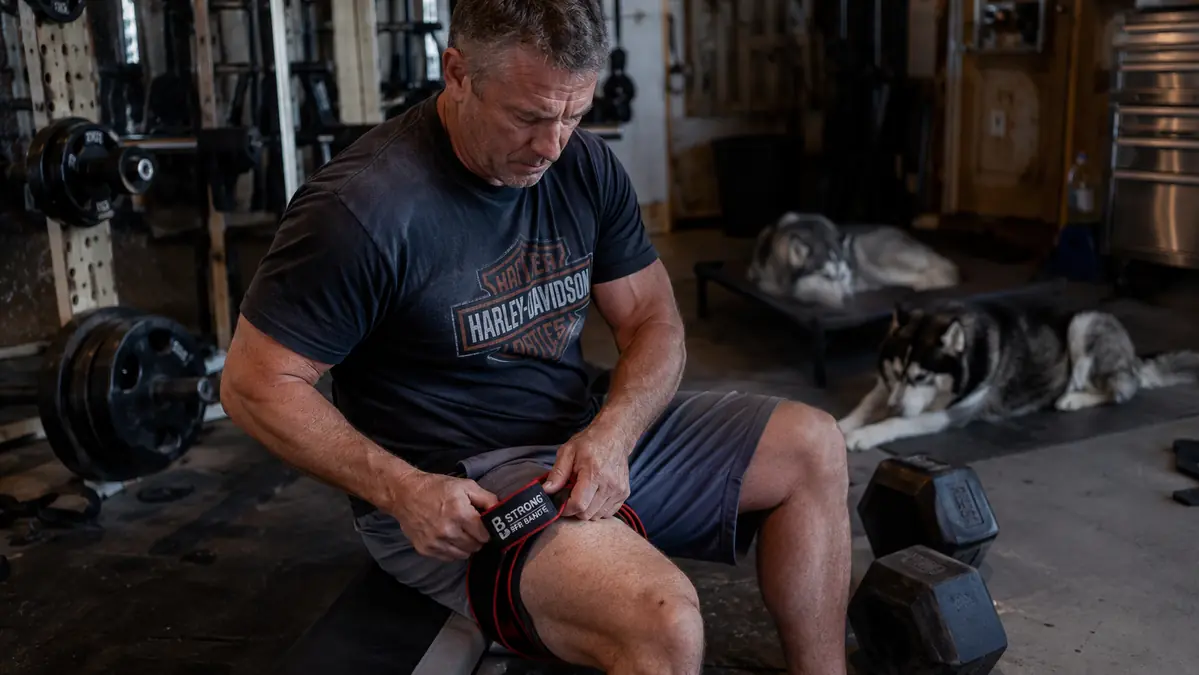
I'm fifty-four, I've been turning wrenches since I was nineteen, and my knees sound like a bag of gravel when I stand up from under a lift. For about six years I told myself the choice was simple: keep lifting heavy the way I always had and pay for it in my joints, or stop lifting and start shrinking. Neither one sat right with me. Then a younger tech at the shop, a kid named Marco who runs marathons on the weekend, showed me a set of blood flow restriction bands he used after a hamstring strain. I bought a set of BFR BANDS PRO the next week, mostly out of curiosity, and it changed how I think about building muscle at my age.
So here's the short answer if you're comparing the two: if your joints are still healthy and you can recover between heavy sessions, traditional strength training with real weight is still the fastest way to get strong. If you're like me and your knees, shoulders, or lower back can't absorb heavy loads several days a week anymore, BFR bands let you keep building muscle with weight you could hand to your grandkid. They're not a replacement for every lift in your program, but they replace enough of them that my joints stopped filing complaints.
I want to be upfront about something before we get into the breakdown. I'm not a physical therapist and I'm not a strength coach. I'm a guy who's spent three decades lying on a creeper under exhaust systems and three decades lifting weights in one garage or another. Everything below comes from actually using both approaches side by side for the last year and a half, not from reading a study abstract and repeating it back to you.
| BFR Bands | Traditional Strength Training | |
|---|---|---|
| Approach | BFR Bands Pro (occlusion training) | Traditional Heavy Lifting |
| Typical load used | 20 to 30 percent of your max | 70 to 90 percent of your max |
| Joint stress on knees/shoulders | Low, weight is light enough that form errors rarely matter | High, especially on squats, bench, and overhead work |
| Session length | 12 to 18 minutes per muscle group | 45 to 75 minutes with warm-up sets and rest periods |
| Recovery time needed | Often ready again in 24 to 36 hours | 48 to 96 hours for the same muscle group |
| Equipment needed | Bands only, works with bodyweight or light dumbbells | Barbell, rack, plates, spotter for heavy sets |
| Raw strength gains (1-rep max) | Modest, not built for max-effort strength | Superior, this is what heavy lifting is designed for |
| Learning curve | Low, wrap and go once you know the pressure | Moderate to high, form matters a lot at heavy loads |
| Cost to get started | Cheap, less than a tank of gas | Expensive if you're buying a rack and plates from scratch |
That table isn't close to a coin flip once you're past your mid-forties with real joint history. The two rows that matter most to me are joint stress and recovery time, because those are the two things that used to knock me out of the gym entirely for a week at a stretch after a heavy squat day. Everything else on that list is negotiable. Those two aren't.
Where BFR Bands Win
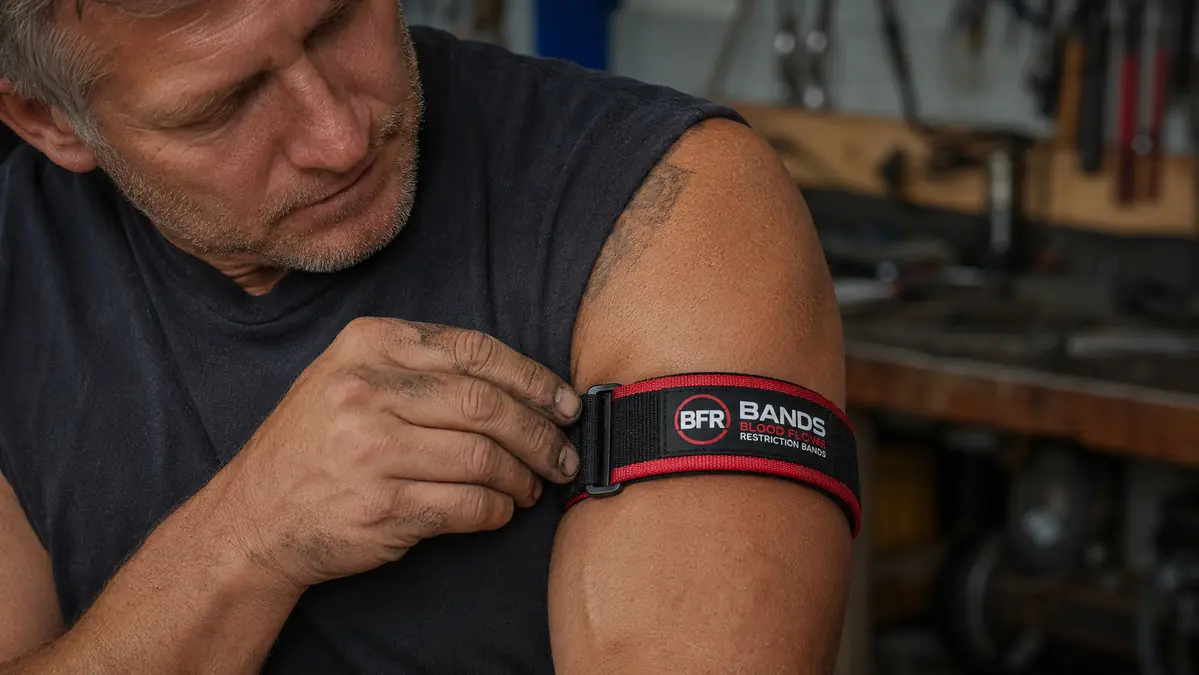
The biggest thing nobody tells you about occlusion training is how little it asks of your joints. I wrap the band about two inches above my knee, do three sets of bodyweight leg extensions or light goblet squats with a 25-pound dumbbell, and my legs are shaking by the third set the same way they used to shake under 225 pounds on the leg press. The band restricts venous blood flow just enough that your muscle fibers think they're under way more stress than they actually are. Your knees never feel a fraction of that load. That's the whole trick.
I was skeptical the first time I tried it, so I timed myself. Three sets of banded leg extensions, forty reps total, six minutes start to finish, and my quads were burning worse than they did after a heavy leg press session that used to take me forty-five minutes with warm-ups. I checked my knee the next morning expecting the usual stiffness from a hard leg day. Nothing. That was the session that convinced me this wasn't a gimmick a younger guy sold me on.
The other place BFR wins is time and recovery. On a day I've been under a truck for nine hours, I don't have it in me to do a 60-minute leg day with a warm-up ladder and four working sets at heavy weight. A BFR session takes me under fifteen minutes and I'm not sore enough the next day to slow me down on the shop floor. I've been able to train legs three times a week for the first time since my thirties, because the recovery cost is so much lower than it is with heavy squats. More frequency with less joint wear has done more for my leg size in the last year than any heavy program I tried in my forties.
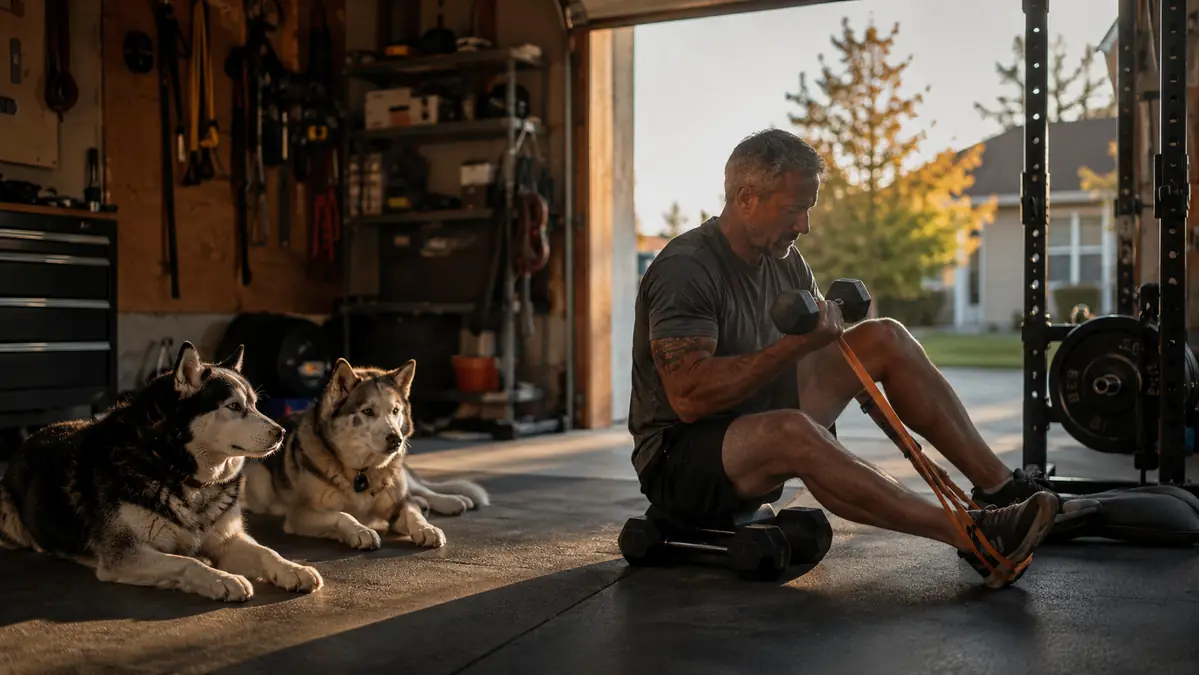
It also helps that the bands travel and store easier than anything else in my garage. I keep a set in my truck's toolbox and I've done arm sets in the parking lot on lunch break more than once, standing next to the bay door while a car's up on the lift waiting for parts. My two huskies, Duke and Nika, have gotten used to lying near the workbench while I do a set of curls with the bands before I take them out for their evening walk. Try packing a squat rack in your lunchbox.
Where Traditional Strength Training Wins
I'll give traditional lifting its due, because pretending otherwise would be dishonest. If your goal is raw strength, the kind you need to move an engine block or throw a transmission jack around the shop, nothing replaces lifting heavy things. BFR bands are excellent at building muscle size and local endurance with light weight, but they don't teach your nervous system to recruit maximum motor units the way a heavy squat or deadlift does. My one-rep max on the bench press hasn't budged much since I started using bands more, and I don't expect it to. That's not what the tool is for.
Heavy lifting also builds bone density and connective tissue strength in a way that light-load occlusion work simply can't match, at least not to the same degree. If you're young, your joints are sound, and you can still recover fast between heavy sessions, I wouldn't tell you to swap out your squat rack for a set of bands. I'd tell you to keep lifting heavy while you can. The bands are what I turned to once heavy lifting started costing me more than it gave back, not before.
BFR bands also don't work well for every muscle group. You can wrap an arm or a leg easily enough, but there's no practical way to occlude blood flow to your back or your chest, so deadlifts, rows, and bench presses stay firmly in the traditional lifting column no matter how much you like the bands. Anyone telling you occlusion training can replace a full-body strength program is selling you something. It's a tool for limbs, not a whole system.
There's also a mental side to it I didn't expect. Loading a bar with real plates and grinding out a heavy set does something for your head that a light band set just doesn't. After a hard week dealing with a difficult customer or a car that fought me the whole shift, putting 275 pounds on my back and squatting it for reps is still one of the few things that clears my mind completely. The bands are useful. They're not that.
Same muscle, none of the knee pain, that's the trade I made
The BFR BANDS PRO set is what got me back to training legs three times a week without my knees paying the tab. Quick-release straps, works for arms, legs, and glutes, and it's cheap enough that trying it isn't a real risk.
Amazon Check Today's Price on Amazon →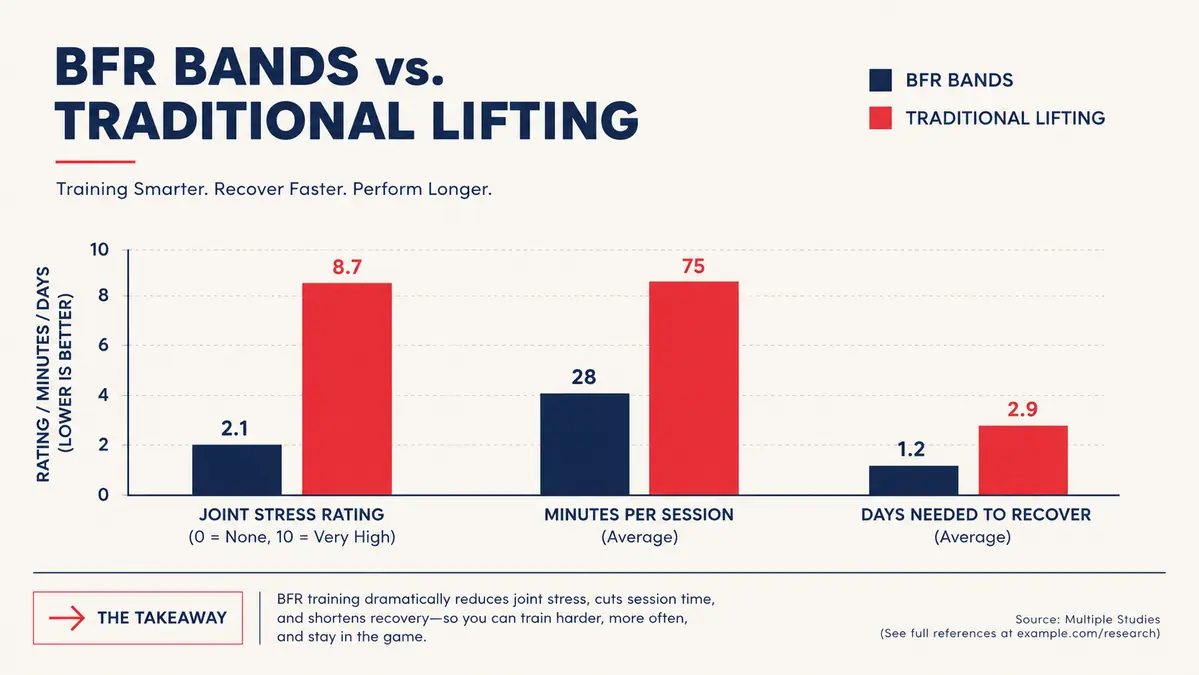
How I Actually Split My Week Now
I don't run one system exclusively, and honestly neither approach demands that you do. My current split runs three heavy compound sessions a week, squats, bench, and deadlift variations, on the days my body feels like it can handle real load. On the two or three days in between, I'll do a fifteen-minute BFR session on arms or legs, usually after work while dinner's cooking. It sounds like a lot until you realize the band sessions barely register as work. My total training time went up. My joint pain went down. That combination surprised me.
The other thing I noticed is that the bands made my heavy days better, not worse. My legs recover faster between heavy squat sessions now because I'm getting extra blood flow and light volume in on the off days instead of doing nothing at all. It's not either-or in practice. It's a rotation, and it's one my forty-year-old self would have laughed at and my fifty-four-year-old knees are grateful for.
Who Should Buy Which
If you're under forty, your joints don't complain, and you're chasing a bigger squat or bench number, put your money into a rack, a bar, and plates, and lift heavy while your body lets you. If you're like me, somewhere past your late forties with a body that's been paying dues for decades, or you're coming back from a knee or shoulder surgery and can't load up heavy yet, a set of BFR bands will let you keep building muscle without adding to the damage. A lot of guys end up doing what I do now, heavy compound lifts on the days my body cooperates, bands on the days it doesn't.
One more honest note before you buy anything. If you've got high blood pressure, a history of blood clots, or any circulation issues, talk to your doctor before you strap anything around a limb and restrict blood flow on purpose. I cleared it with mine first given my age, and I'd tell any guy in his fifties to do the same instead of just ordering a pair off Amazon and wrapping them on blind.
You don't have to pick a side forever. You just have to be honest about which one your joints can afford that day. I ignored that advice for years and paid for it with a knee that clicked every time I climbed a ladder. I'm not doing that again.
Your knees get a vote too, give them one
I wish I'd tried BFR bands ten years earlier instead of grinding through heavy leg day on bad knees out of stubbornness. The BFR BANDS PRO set ships fast, fits arms or legs, and costs less than a couple of fast food lunches.
Amazon Check Today's Price on Amazon →