

Thirty-one years of leaning back under dashboards and craning my neck up into wheel wells will do something to a man's cervical spine that no amount of stretching in the world quite undoes. By the time I turned 53 I couldn't check my truck's blind spot without a dull grinding ache that ran from the base of my skull down between my shoulder blades, and some mornings I'd wake up unable to turn my head past the windshield pillar without wincing. My doctor mentioned cervical traction almost in passing, the kind physical therapists use in clinic with a pulley and a chin strap, and said there were cheaper versions people used at home. That's how I ended up with the Lumia Wellness cervical traction block sitting on my nightstand in January 2026, a firm foam wedge that costs less than one PT copay and doesn't require an appointment.
I want to be upfront that I was skeptical. I've bought enough gadgets off Amazon over the years, a vibration plate that gathered dust, a knee sleeve that did nothing, to know that half of what gets marketed as recovery gear is just foam and hope. But a firm wedge you lie back on for ten minutes a night is about as low-risk as recovery gear gets, so I gave it six months, tracked it the same way I track everything else in a little notebook by my bed, and I'm going to walk through exactly what changed and what didn't.
The Quick Verdict
A genuinely useful, no-frills piece of gear that earned a permanent spot on my nightstand, but it takes patience the first couple weeks and it will not fix a real disc problem.
Amazon Check Today's Price →Six months of nightly use on a neck wrecked by three decades under the hood, here's what actually loosened up
If you spend your days looking up, hunched forward, or staring at a screen, and your neck has started paying the price, this firm little Lumia Wellness wedge is the cheapest thing I've tried that actually moved the needle.
Amazon Check Today's Price on Amazon →How I've Used It
My routine is dead simple, which is the only reason it stuck. Every night after I brush my teeth, I lie flat on my back on the rug next to my bed, set the block under the base of my skull the way the little insert card shows, and let my head hang back into the curve of it for about ten minutes while I scroll the shop's parts orders on my phone or just stare at the ceiling fan. Some nights it's eight minutes because I'm dead tired, some nights it's fifteen because a hot shower loosened things up and it felt too good to stop. I didn't miss more than a handful of nights across six months, and I credit that consistency more than anything else for the results.
I learned early that positioning matters more than the marketing photos let on. The first week I kept sliding it too high, right under the crown of my head instead of the base of my skull, and all it did was flatten my neck uncomfortably without any real traction feel. Once I dropped the Lumia Wellness block down about an inch and a half, right where my skull meets my neck, I actually felt the stretch the device is supposed to create, a gentle pulling sensation along the sides of my neck instead of pressure on the back of my head. That adjustment alone made the difference between this thing working and this thing sitting unused in a drawer.
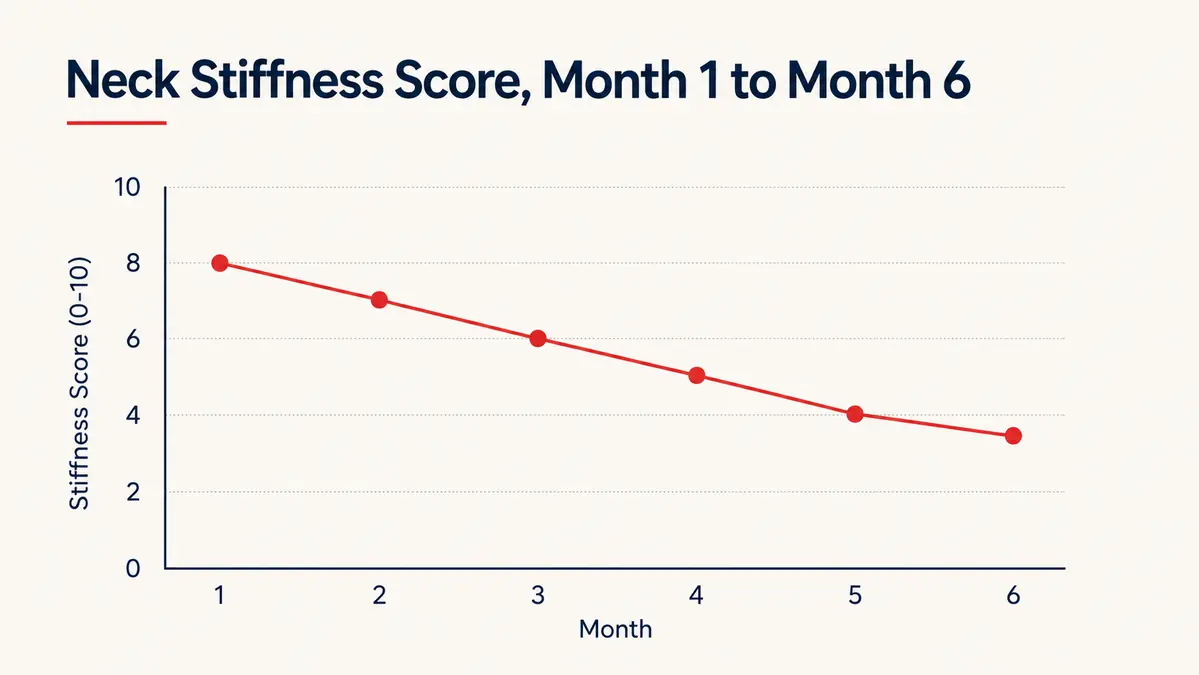
I logged three things every night in the same notebook I use to track torque specs and oil change intervals at the shop: how stiff my neck felt on a scale of one to ten before I laid down, how it felt right after, and how it felt the next morning checking my blind spot backing a truck out of a bay. That log is the only reason I trust what I'm about to tell you, because six months of twelve-hour shop days blur together fast, and I didn't want to just go off a gut feeling.
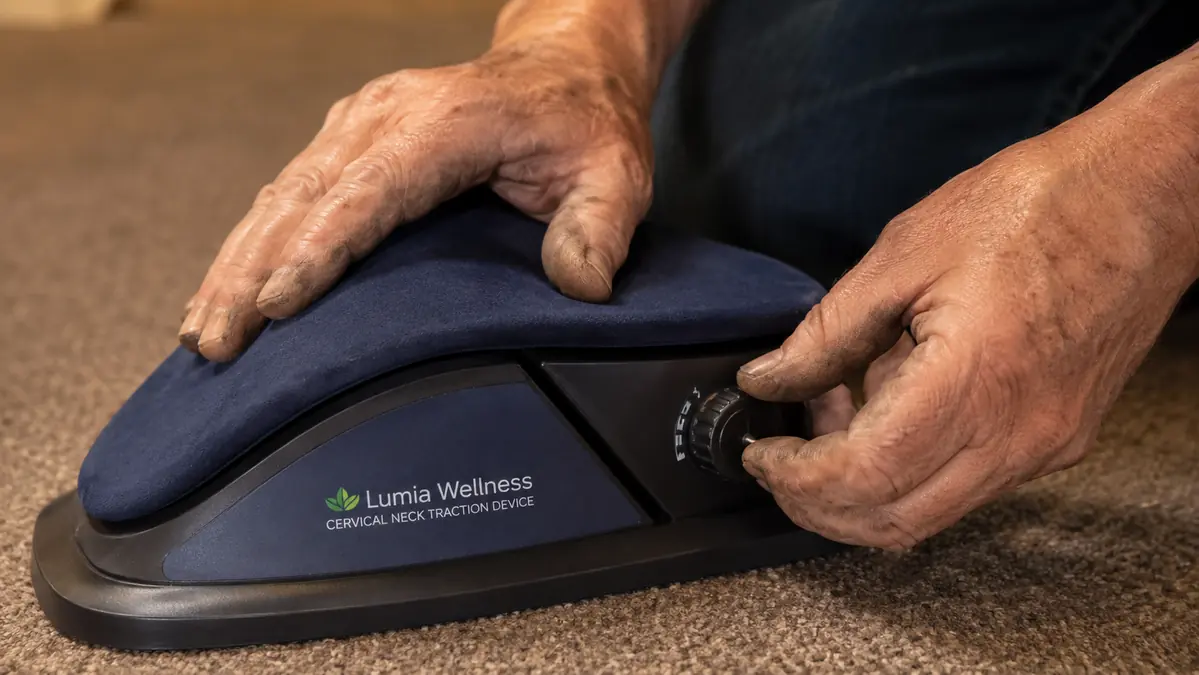
What This Thing Actually Is
The Lumia Wellness block is not a pump-up inflatable collar and it's not a pulley rig hanging off a doorframe. It's a firm, wedge-shaped block of dense foam, roughly the size of a thick paperback, with a curved cutout designed to cradle the base of your skull while your head tips back over the edge. Gravity and the shape of the wedge do the work, there's no motor, no straps, no batteries, nothing to charge or break. That simplicity was actually the selling point for me. I've had enough gadgets around the shop and the house fail on cheap electronics that a piece of dense foam felt like the one thing that couldn't break down on me.
The foam is genuinely firm, closer to the density of a yoga block than a pillow, which surprised me the first night. I'd expected something softer and was ready to send it back until I realized the firmness is the point, a soft foam wedge would just compress under the weight of your head and give you nothing. It held its shape the entire six months with no visible sagging or flattening, which is more than I can say for the memory foam pillow I bought around the same time.
There's a small folded instruction card in the box, thinner than I'd have liked, showing the basic head position and a suggested duration to start with. It doesn't go much beyond that. No app, no follow-along video, nothing fancy. For a guy who just wants to lie down and let a piece of foam do its job, that was fine by me, but if you want hand-holding through the process you'll need to look up a physical therapist's video on cervical traction positioning, which I ended up doing anyway in week one just to make sure I wasn't doing something dumb to my own neck.
Six Months In: What Changed
The first real change I noticed came around week three, not month one like I'd hoped. My neck stopped making that grinding crackle sound when I turned to check the passenger seat, a sound I'd gotten so used to I'd stopped mentioning it to anyone. By month two, backing trucks out of the bay, a motion that requires turning my head almost 90 degrees over my right shoulder, stopped triggering that sharp catch I used to get maybe three or four times a week. I started noticing its absence before I noticed the stretching feeling working, which tells you something about how much that catch had become background noise in my life.
By month four I did something I hadn't done in years, I turned all the way around to grab a socket off the tool cart behind me without pivoting my whole torso first. My wife used to tease me for years about turning like a tank instead of an owl, and she's gone now, but I thought about her the day I caught myself doing it and realized nobody was there to notice but Diesel and Nova, my two huskies, who don't care one way or the other. Small thing, but it landed.
I also started sleeping through the night more consistently, which I hadn't expected as a benefit going in. I used to wake up around 3am some nights from a dull ache radiating up into the back of my head, and that happened maybe two or three times a month by June instead of the six or seven times a month it was happening back in January. I can't prove causation with a sample size of one guy and a notebook, but the timing lines up too well for me to call it coincidence.
What didn't change: I still get stiff by hour ten of a long shop day, especially in cold weather when I'm bent up under a truck for an extended alignment job. This isn't a cure for whatever's actually going on structurally in my cervical spine after three decades of looking up at the underside of vehicles. It's a tool that takes the edge off consistently, and after years of just living with the grinding and the catch, taking the edge off consistently is worth a lot more than it sounds like on paper.
The Tradeoffs Nobody Mentions
The firmness that makes this thing work is also the thing that makes the first week or two genuinely uncomfortable. I'm not going to sugarcoat it, lying with your head tipped back over a firm foam edge feels strange and mildly unpleasant the first several sessions, closer to a deep stretch than anything relaxing. If you go in expecting a spa experience you'll be disappointed and probably quit before it starts helping. I almost did. It took about ten sessions before it started feeling like relief instead of just an odd sensation I was tolerating.
It's also entirely on you to get the positioning right, and the instructions don't go into nearly enough depth for a true first-timer. I spent twenty minutes on my phone watching a physical therapist's video on proper cervical traction setup before my third session, and I'd tell anyone buying this to do the same before they ever lie down on it the first time. Get the position wrong and you're either getting nothing out of it or putting strain somewhere you didn't intend to.
One more honest note. This is not something I'd use if I had any diagnosed disc herniation, spinal instability, or a doctor telling me to avoid neck extension. I don't have any of those issues, mine is straightforward mechanical stiffness from decades of posture, and I checked with my doctor before starting just to be safe. Anyone with a more serious underlying condition needs to have that conversation before they ever put this under their neck.
Alternatives I Considered First
I looked at the inflatable air-pump cervical collars first, the kind you wear upright at your desk and pump up with a squeeze bulb. They run more expensive and I read enough reviews from people saying the seal fails within a few months to steer away from anything with moving parts and air chambers. For a guy who's already replacing enough gaskets and seals at work, I wasn't excited to add one more thing at home.
I also thought hard about just booking regular chiropractic adjustments instead. I did two rounds of that back in 2023 and it helped in the moment, but the relief never lasted more than a few days and the copays added up fast for a guy running a shop with unpredictable income some months. This block is a one-time purchase that I use every single night, no appointment, no copay, no driving across town on my one day off. That math mattered as much as the actual relief did.
The other option I considered and skipped entirely was one of those motorized neck massagers with heat settings and a dozen buttons. I've got enough electronics failing on me in the shop, I wasn't interested in bringing that headache home too. A solid block of foam that can't short out or need a firmware update had real appeal after a career spent fixing things other people's gadgets broke.
What I Liked
- Simple, no batteries or moving parts to fail after six months of nightly use
- Firm foam held its shape the entire test period with zero sagging
- Noticeable reduction in the grinding and catching sensation turning my head
- Cheaper than a single physical therapy copay where I live
- Ten minutes a night fits around any schedule, even a twelve-hour shop day
Where It Falls Short
- Included instructions are too thin for a true first-timer to get positioning right
- First week or two feels genuinely uncomfortable before any benefit shows up
- Not a fix for real disc or spinal issues, just mechanical stiffness relief
- Requires consistent nightly use, skip a couple weeks and stiffness creeps back
- Firmness surprised me and won't suit anyone expecting a soft, cushioned feel
I've spent thirty years fixing things that broke because somebody skipped the boring maintenance step. Turns out my own neck needed the same lesson, ten minutes a night, no shortcuts.

Who This Is For
If your work or your posture has you looking up, hunched forward, or locked into one position for hours at a time, mechanics, welders, folks glued to a monitor, anyone who's noticed their neck getting stiffer and less mobile over the years, this is worth trying. It's also a solid option if you've tried chiropractic care and found the relief doesn't last, since this gives you a daily maintenance tool instead of a once-a-week reset. If you're patient enough to push through an uncomfortable first couple weeks and disciplined enough to actually use it every night instead of letting it become a nightstand decoration, you'll get real value out of it.
Who Should Skip It
If you've been diagnosed with a herniated disc, spinal stenosis, or any structural cervical condition, talk to your doctor before you ever put this under your neck, and don't take my word over theirs. It's also not for anyone looking for instant relief in one or two sessions, because that's not how this works, and if you bail after three uncomfortable nights you'll never see the payoff I saw by week three. If your neck pain is sharp, radiating down an arm, or came on suddenly after an injury, that's a doctor visit, not a foam wedge.
If three decades of looking up under vehicles has wrecked your neck the way mine did, this is the fix I wish I'd tried years sooner
Six months of nightly logs, a grinding sound that finally went quiet, and a neck that turns without the catch it used to have. That's what changed for me. Here's where to get the same one.
Amazon Check Today's Price on Amazon →