

Thirty years of looking up under trucks does something to a man's neck that no amount of stretching in the shop bay ever fixed for me. By the time I get home most nights, the back of my neck feels like somebody's got a pipe wrench clamped down on it, and turning my head to check my mirrors driving home has become its own little chore. I'm 54, I've been a mechanic since I was 23, and the stiffness crept in slow enough that I didn't notice how bad it had gotten until I couldn't look over my shoulder to back the tow truck up without turning my whole body.
What follows is the actual routine I run most nights with a Lumia Wellness cervical traction block, not some textbook version pulled off a physical therapy pamphlet. Five steps, nothing fancy, and a section at the end on what else I do around it because a foam block alone was never going to undo three decades of looking up at exhaust manifolds. If your neck locks up the same way mine does after a long day, this is the routine that actually moved the needle for me.
I want to be straight about what this thing does before you set one on your living room floor. It's not a chiropractor's table and it's not going to fix a bad disc or a pinched nerve. What it does is put a gentle, steady stretch on the muscles and joints in your neck that get compressed and locked down from hours of looking down at an engine bay, a laptop, or a windshield. That's a specific job, and once I stopped expecting it to be a cure-all, I started using it right and actually got somewhere with it.
Fifteen minutes flat on your back is all this takes.
The Lumia Wellness cervical traction block is the firm foam wedge I use every night to unlock my neck before bed. Check today's price and current rating on Amazon before your first session.
Amazon Check Today's Price on Amazon →Step 1: Find a flat, firm surface and set the block up right
This isn't something you do on a soft mattress. I use a thin yoga mat on the living room floor, right where I can still see the TV, because a mattress sinks and cancels out the traction effect before it even starts. The floor gives the block something solid to push against, and that's the whole mechanism, gentle steady pressure that gaps the vertebrae in your neck instead of letting your head sink into a pillow.
The block itself has a curved shape built for the base of your skull and the top of your neck, not the middle of your back or your shoulders. The first couple times I set it too high, right under my skull, and it felt like somebody was trying to pop my head off. Once I dropped it down an inch or so, right where my neck meets my shoulders, the pressure spread out and actually felt like relief instead of a fight.
I keep a thin folded towel nearby too. Some nights, especially early on, the firm side of the block was more intensity than my neck could handle after a rough day, and laying the towel over it softened things just enough that I could stay down for the full session instead of tapping out after ninety seconds.
The build quality matters more than I expected going in. I've tried a cheap inflatable neck wedge from a big box store years back and it lost its firmness inside a month, went soft in the middle and stopped doing anything. The solid foam block holds its shape session after session, which sounds like a small thing until you're the guy who has to replace a flimsy one every few weeks and just gives up on the whole routine instead.

Step 2: Lie down slow and let your neck settle before you judge anything
I ease down onto the block instead of dropping my head onto it, same way I'd lower a transmission onto a jack, controlled, not rushed. The first thirty seconds almost always feel like too much. My neck muscles tense up on instinct because they're not used to being stretched instead of squeezed all day, and that initial resistance is normal, not a sign something's wrong.
I close my eyes and just breathe for that first stretch, slow breaths in through the nose, longer breaths out. That sounds like something out of a yoga class and I'd have laughed at it a few years back, but the breathing is what actually lets the muscles in my neck let go of the tension they've been holding onto since I climbed under a truck at seven that morning. Fighting the position with tense shoulders just fights the whole purpose of the block.
By about the two-minute mark, my neck usually gives that first release, a soft pop or a wave of warmth spreading across my shoulders. That's the signal I'm settled in and the traction is doing its job instead of me just lying on a foam wedge waiting for something to happen.
I keep my arms flat at my sides during this whole process, palms down, nothing crossed over my chest. Crossing my arms used to pull my shoulders up toward my ears without me realizing it, and that tension travels straight up into the neck and undoes half of what the block is trying to do.
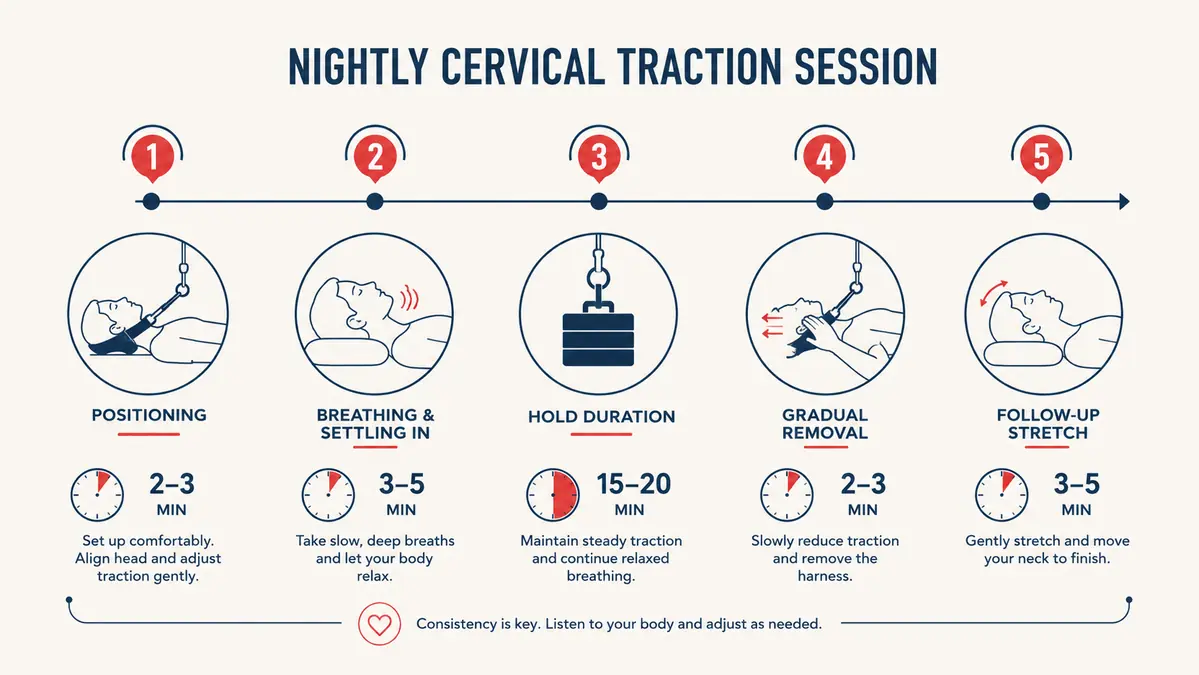
Step 3: Hold the position for ten to fifteen minutes, not longer
I set a timer on my phone every single time because it's too easy to either bail out early or fall asleep on the thing and end up there for forty-five minutes, which isn't the goal. Ten minutes is my floor, fifteen is my ceiling on a normal night. Longer than that and I've noticed my neck actually feels more irritated the next morning instead of looser, probably because I'm holding a static stretch well past the point it's doing me any good.
During the hold I'll gently turn my head an inch to the left, back to center, an inch to the right, real small movements, nothing dramatic. That small range of motion while the traction's doing its work seems to work through the stiff spots on the sides of my neck that a straight-on stretch doesn't always reach. It's not a big rotation, just enough to feel where the tightness actually lives that night.
Some nights ten minutes feels like plenty and I'm itching to get up by minute eight. Other nights, usually after a day of working on something up high like a lifted truck's undercarriage, I want the full fifteen and I still feel like I could use more. I let the day dictate it inside that ten to fifteen window instead of forcing the exact same number every single time.
If anything sharp shows up, not the dull stretch feeling but an actual sharp pain, or numbness and tingling that runs down an arm, that's my cue to come off the block right then and not push through it. I've never had that happen in the year I've been using this, but I'd tell any buddy the same thing I'd want told to me, listen to the difference between a stretch that's working and pain that's warning you off.

Step 4: Come off the block slow, don't pop straight up
Getting up too fast after a session is the mistake I made the most in the first couple weeks. I'd finish the timer and just sit straight up like I was getting out of a truck seat, and it would undo half the loosening I just spent ten minutes earning. Now I roll onto my side first, push up slow with my arm, and let my neck come along for the ride instead of snapping upright.
Once I'm sitting up, I give it a solid thirty seconds before I do anything else, no reaching for my phone, no standing up to grab a glass of water. Just sitting there letting my neck adjust back to holding my head up on its own after being supported by the block. There's usually a light, loose feeling right in that window that's worth just sitting with for a minute.
If I stand up too fast, I'll notice a little dizziness, nothing scary, just the same head-rush feeling you get standing up too fast from any lying-down position. Taking the thirty seconds sitting up first has cut that out almost entirely.
Step 5: Follow it with a short stretch, not a full workout
Right after the block comes off, I do a few slow neck rolls, chin to chest, ear toward each shoulder, hold each one for about ten seconds. This isn't a real workout, it's just a way to walk my neck through its normal range of motion while it's still loose from the traction, before I go sit on the couch and let it tighten right back up watching TV for two hours.
I do this most nights, five or six times a week, sometimes skipping a night if I'm dead on my feet or the huskies need a longer walk than usual before bed. Consistency's what actually built the change over time, not any single session. The first month I noticed I could check my mirrors without turning my whole torso. By month three, the pipe-wrench feeling at the base of my skull had mostly quit showing up at all, only coming back after the roughest days under a lifted vehicle.
I keep the block sitting right next to the couch instead of tucked away in a closet, because if I have to go dig for it, some nights I just won't bother. Having it out where I can see it has done more for my consistency than any amount of willpower ever did. Same reason I keep my good wrenches on the top tray instead of buried in a drawer, the tools you actually use are the ones that stay in reach.
What Else Helps
The traction block loosens things up, but it doesn't fix what's causing the tightness in the first place, which for me is thirty years of looking up while my shoulders round forward. So I've made a point of checking my posture at the shop more than I ever used to, dropping my chin level and pulling my shoulders back whenever I catch myself hunched over an engine bay for too long. I also switched to a firmer pillow at home, one that keeps my neck in a neutral line instead of letting my head tilt off to one side all night, which was undoing the block's work before I even woke up.
Walking helps more than I expected too. Most evenings I take Deacon and Luna, my two Siberian huskies, around the block before I do my traction session, and just getting my shoulders moving and my blood flowing seems to make the block work better once I do lie down. A hot shower before bed on the nights my neck's especially locked up does something similar, loosens the muscle enough that the traction doesn't have to fight through as much resistance to get to the actual stiffness underneath.
I also adjusted the mirror and seat position in my truck once I actually paid attention to how much I was craning my neck to see around the pillar every time I backed up. Small thing, took ten minutes to fix, and it cut down on one of the repeated bad habits that was feeding the stiffness in the first place. If you've got high blood pressure, a history of neck surgery, or any condition your doctor's flagged with your spine, talk to them before you start a routine like this. I'm not a physical therapist, I'm a mechanic who pays attention to his own body, and that's the level of caution I'd want any buddy of mine to use too.
The block doesn't undo thirty years of looking up under trucks. It just gives my neck ten minutes a night where nothing's asking it to hold anything up.
Ten minutes on your back, most nights, is the whole routine.
If your neck locks up the same way mine used to after a long shift, the Lumia Wellness cervical traction block is the tool I'd hand a buddy in the same spot I'm in. Check today's price and current rating on Amazon before your first night with it.
Amazon Check Today's Price on Amazon →