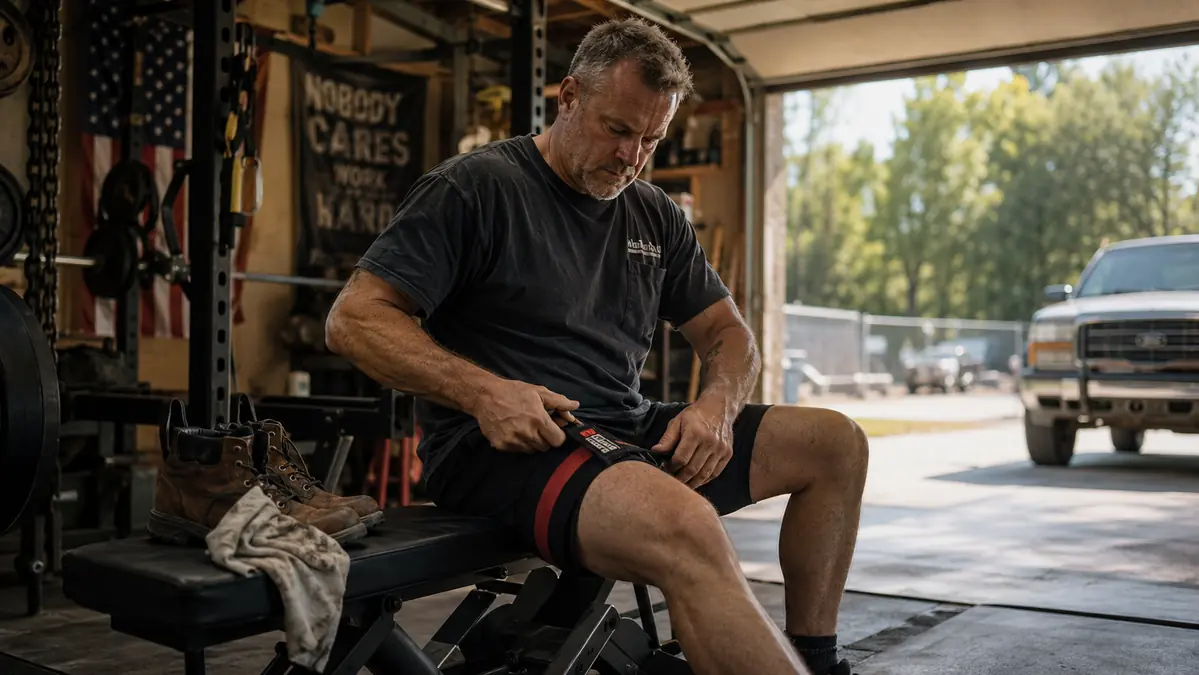
I spend most of my day on a creeper under somebody's truck or hunched over a fender, and by the time I clock out my knees feel like they belong to a man twenty years older than me. I'm 54. I still want to keep muscle on my frame, but my joints have taken enough pounding from four decades of wrench work that loading up a barbell five days a week just isn't smart anymore. That's the problem BFR bands actually solve, not some gimmick promise, just a real way to trigger a muscle-building response with weight my knees and shoulders can tolerate.
I've been running these BFR Bands Pro bands a few times a week for months now, mostly on my legs, sometimes on my arms after a day of turning bolts has already worked my forearms half to death. What follows is the actual routine I use, not a textbook version. Five steps, nothing fancy, and a section at the end on what else I stack with it to actually recover faster instead of just training harder.
I want to be clear about what this routine is and isn't before you dive in. It's not a way to skip real strength work forever, and it's not going to fix a torn meniscus or a bad rotator cuff. What it did for me was give me a way to keep training through a stretch when my right knee was too inflamed for squats and lunges, and it kept my legs from shrinking while I waited that out. That's the honest use case, and it's worth more to a guy my age than another miracle claim.
Skip the guesswork. This is the band I actually use.
BFR Bands Pro has the quick-release buckle and the width that doesn't dig into skin the way the cheaper elastic wraps do. Check today's price and rating on Amazon before you start your first session.
Amazon Check Today's Price on Amazon →Step 1: Wrap the band in the right spot, not just wherever's easy
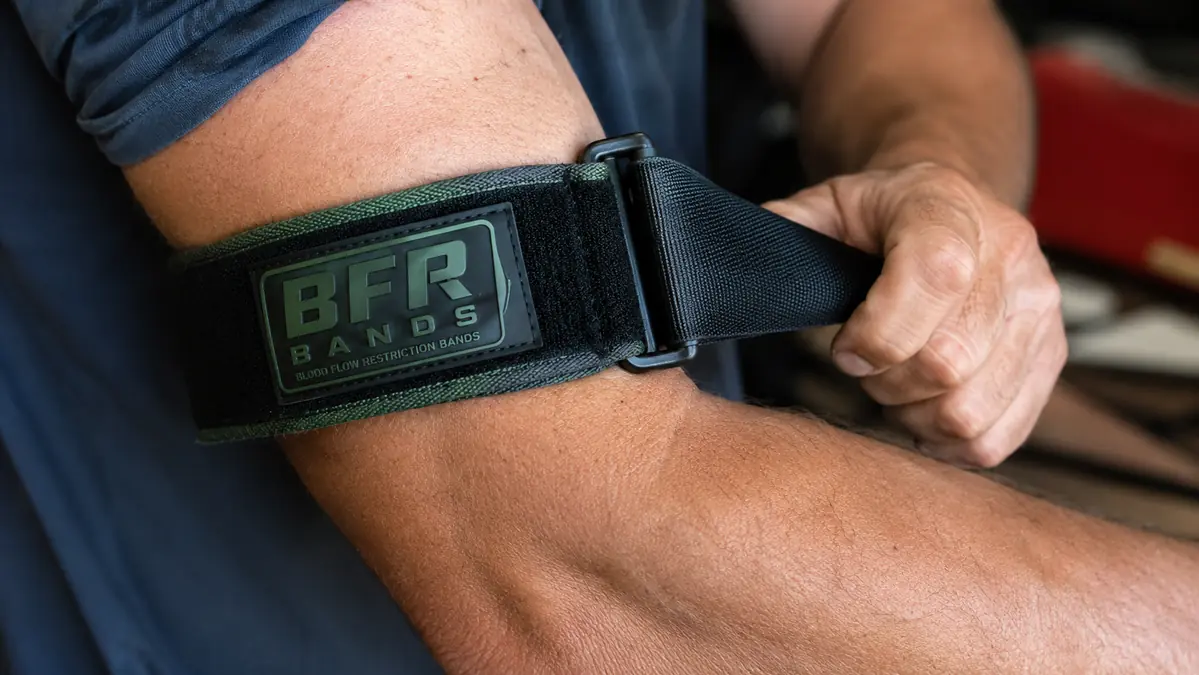
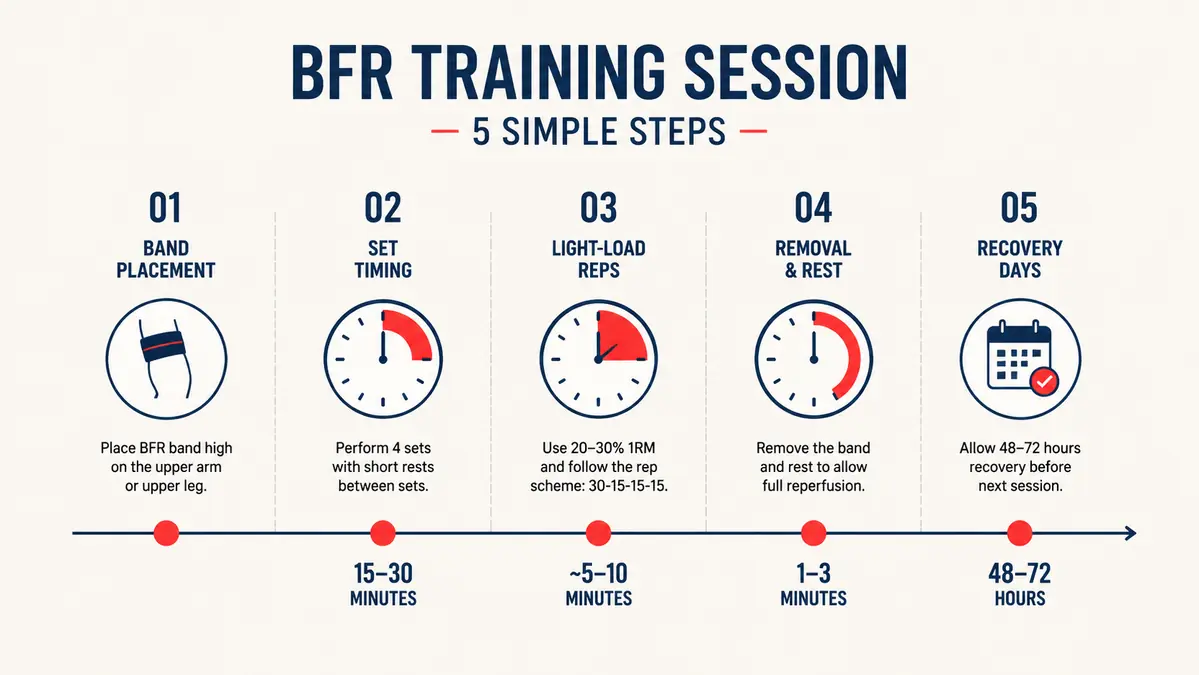
Placement matters more than almost anything else with occlusion training. For legs, the band sits at the very top of the thigh, right up near the groin crease, not mid-quad. For arms, it sits high on the bicep, close to where your shoulder meets your arm. If you wrap it lower, you're not restricting the right blood vessels and you're just wasting your time.
The first few weeks I had the band sitting too low on my thighs because that felt more natural, and I wasn't getting the pump or the burn people talk about. Once I moved it up higher, right where the bands are designed to sit, I felt the difference in the first set. My legs went from feeling like I'd done a light warm-up to feeling like I'd run a hill sprint, in under three minutes.
Tightness is the other half of placement. You want the band snug enough that you feel pressure, but your foot or hand shouldn't go numb or change color. A good rule I use, the band should feel like a 7 out of 10 on tightness. Tight enough to restrict venous return, loose enough that you're not cutting off circulation entirely.
The quick-release buckle on these bands is the reason I trust wrapping them tight in the first place. My hands are beat up, scarred knuckles, a couple fingers that don't bend all the way from old shop accidents, and I need a strap I can undo one-handed in a second if something feels off. A band that needs two good hands to unclip isn't one I'd trust on my own leg.
Step 2: Keep the sets short and the reps high
This isn't a heavy lifting day. The whole point of BFR is that you use light weight, sometimes just bodyweight, and you get a muscle-building response similar to what heavy lifting does, without the joint stress. My typical leg session with the bands is bodyweight squats or a light dumbbell, 30 reps on the first set, then 15 reps for three more sets, with only 30 seconds of rest between them.
That rest period matters. You don't want to give your muscles a full recovery between sets, that's the whole mechanism, the bands keep blood pooled in the limb and the short rest keeps it that way. If I rest a full two minutes like I would on a normal leg day, I'm undoing the point of wearing the bands in the first place.
The whole working portion of a BFR session, band on to band off, runs about 12 to 15 minutes for me. That's the part that sold me on this as a guy with a limited window before the shop opens. I'm not carving out an hour, I'm doing four sets, taking the band off, and I'm done.
I don't chase a number on the last set anymore, I chase the burn. Somewhere around rep 12 to 15 on those later sets, my quads or my biceps start burning in a way that regular light reps without the bands never produce. That burn is the signal I'm actually in the zone this is supposed to create, and once I feel it, I know the set did its job whether I hit exactly 15 reps or had to stop at 11.
Step 3: Pick exercises that don't need a full gym setup
You don't need a rack or a bench for this to work. Bodyweight squats, glute bridges, calf raises, and step-ups off my tailgate cover my legs. For arms, I use a pair of light dumbbells I keep in the garage, curls and tricep pushdowns with a resistance band anchored to the workbench. None of it requires real weight because the bands are doing the heavy lifting, not the load.
This is where a lot of guys mess it up. They put the bands on and then load up like it's a normal training day, going for a weight that's actually challenging on its own. That defeats the purpose and it's honestly dangerous with restricted blood flow. I keep the load at maybe 20 to 30 percent of what I'd normally lift without the bands.
I also rotate which muscle group gets the bands depending on what my body's telling me. If my knees are barking after a day of kneeling on concrete, I'll do an upper body BFR session and leave the legs alone. If my forearms are cooked from gripping a ratchet all day, legs get the bands instead. Listening to what's actually sore keeps this sustainable instead of something I dread.
On days I'm short on time, I'll stack two exercises back to back for the same limb instead of resting between them entirely, calf raises straight into a wall sit for legs, or curls straight into a slow tricep extension for arms. It keeps the whole thing under 15 minutes without cutting corners on the actual work.

Step 4: Take the bands off the second something feels wrong
This is the step guys skip and it's the one that matters most. Numbness, tingling, sharp pain, or your fingers and toes turning a strange color, any of that means the band comes off immediately. I've never had a real problem in months of using these, but I also don't leave a band on for more than about 15 minutes total in one session, and I never sleep or drive with one on, which sounds obvious but I've read enough forum posts to know somebody's tried it.
After I take the band off, I give the limb a minute before I stand up and walk around, just to let normal blood flow catch up. There's usually a rush of warmth and a deep muscle pump right after removal, that's normal and honestly it's one of the more satisfying parts of the whole routine, it tells me the session did something.
If you've got high blood pressure, a history of blood clots, or any circulation condition, talk to a doctor before you strap these on. I'm not a physical therapist, I'm a mechanic who reads the instructions that come with the product and pays attention to his own body, and that's the level of caution I'd tell any buddy of mine to use too.
I also check the color of my hand or foot before I even start a set, not just after. If it's already looking off before rep one, the band went on too tight and I loosen it a notch before continuing. Better to lose thirty seconds resetting the strap than push through something my body's clearly telling me to back off from.
Step 5: Build recovery days around the sessions, not just around soreness
I run BFR sessions three times a week, Monday, Wednesday, and Saturday, and I treat the days between as actual recovery, not just days I happen to skip training. That means more water than I used to drink, a protein shake after the session, and getting to bed at a decent hour even when there's a truck in the bay that needs to be done by morning.
The recovery side is where BFR actually earns its spot in my week. Because the sessions are short and low-impact on the joints, I'm not sitting there the next day too wrecked to walk down the stairs, which used to happen after a heavy squat day. My legs feel worked, not destroyed, and that's let me be consistent in a way I never was with traditional lifting at my age.
I keep a simple log on my phone, just the date and which limb got the bands, so I'm not accidentally doing legs three days in a row or forgetting an arm day entirely. It takes ten seconds and it's kept me honest about actually spacing things out instead of winging it.
Some weeks the shop gets slammed and three sessions turns into two, and I've made peace with that. The bands aren't going anywhere and neither is the muscle I've built with them, as long as I don't let two sessions turn into zero for a month straight. Consistency over a long stretch beats a perfect week followed by three weeks of nothing.
What Else Helps
BFR bands aren't a whole recovery plan by themselves. I still stretch for five minutes before bed, mostly hips and calves, because years of standing on concrete shop floors will tighten those up no matter what else you're doing. I also try to get outside and walk my two huskies, Deacon and Luna, most evenings, not for exercise really, just to keep moving instead of collapsing on the couch the second I get home.
Sleep is the other piece nobody wants to hear about. I didn't take it seriously for years and my recovery showed it. Once I started actually protecting seven hours a night, the soreness from BFR sessions cleared faster and I stopped feeling like I was dragging myself through Tuesdays. Food matters too, and I don't mean anything complicated, just getting enough protein across the day so the muscle these short sessions are working to build actually has something to build with.
The bands don't do the recovering. What you do in the 23 hours you're not wearing them does the recovering. The bands just buy you the time.
Fifteen minutes, three times a week, is all this routine takes.
If your joints can't take another heavy lifting day but you still want to hold onto muscle, BFR Bands Pro is the tool I'd hand a buddy in the same spot I'm in. Check today's price on Amazon and see the current rating for yourself.
Amazon Check Today's Price on Amazon →