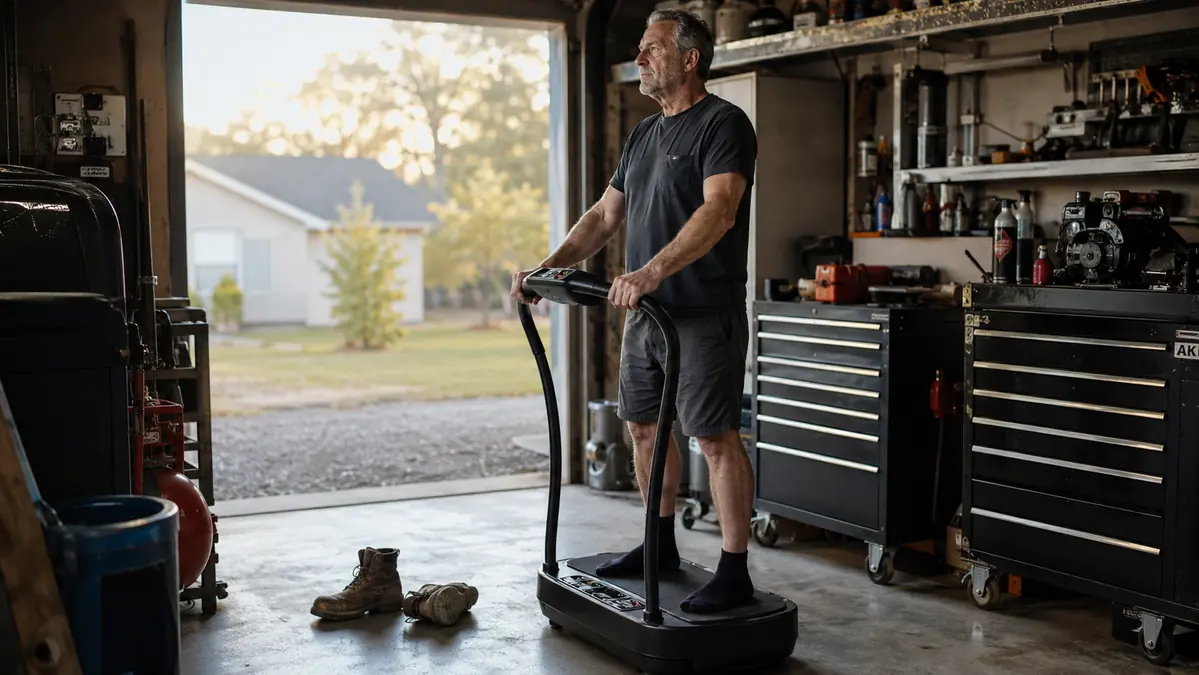
By two in the afternoon my feet and calves used to feel like they were full of wet sand. Twelve years of standing on a concrete shop floor will do that to a man. I'm 54, my knees have taken enough abuse that I'm careful with them, and for a long stretch I just accepted the swelling and the heaviness in my legs as part of the job. Then a customer of mine, a nurse who's on her feet all shift too, mentioned she used a vibration plate at home to get her legs moving again before bed. I was skeptical. It looked like a gimmick to me, another thing that shakes and hums and does nothing.
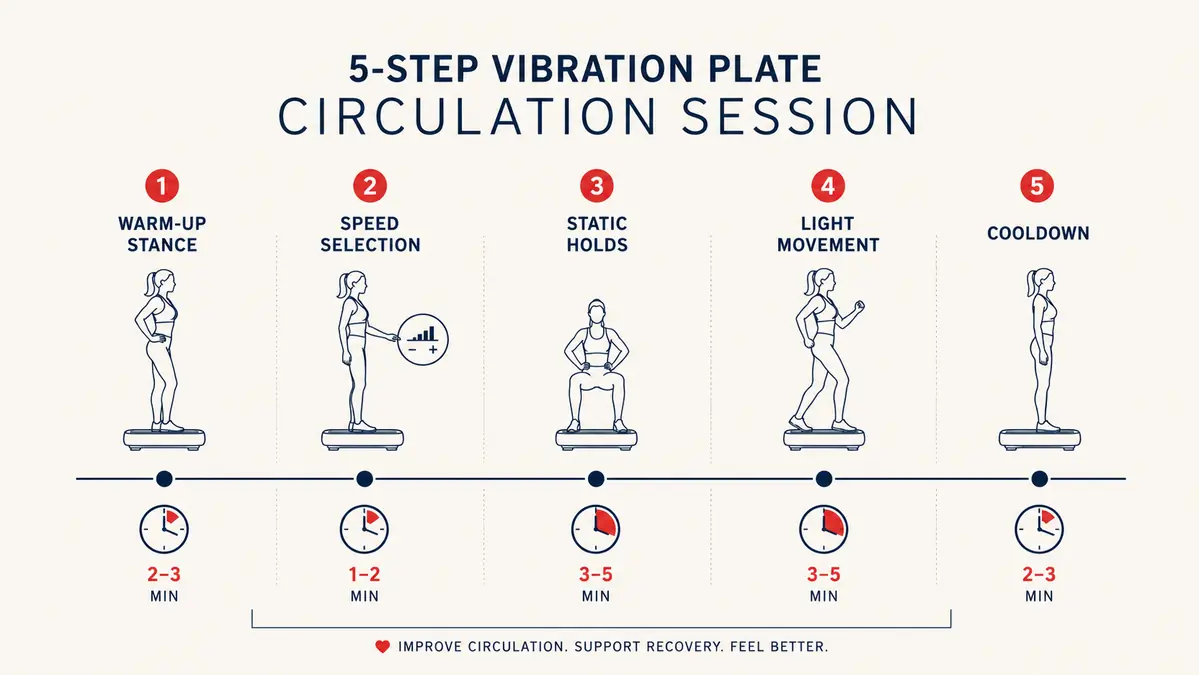
I was wrong about that, at least for the specific problem of sluggish circulation after a day of standing still or sitting in a truck cab. This isn't a fat-loss machine and it's not going to build muscle like a real workout. What it does, and what I've felt myself, is get blood moving back up out of your lower legs when gravity and a long day have pooled it down there. Here's the actual routine I run on my Lifepro Rumblex, five steps, nothing complicated, plus what else I stack with it to keep my legs from feeling like bricks by dinner time.
I want to be straight about what this does and doesn't fix before you get into it. It's not going to reverse a real vascular condition, and if you've got diagnosed poor circulation, varicose veins, or a history of blood clots, that's a conversation for your doctor, not a mechanic's blog. What it did for me was take the heavy, swollen feeling out of my calves most evenings and cut down on the leg cramps that used to wake me up at two in the morning. That's a real result, and it's the one I'd tell any buddy standing on concrete all day to expect.
Get your blood moving before your legs give out on you.
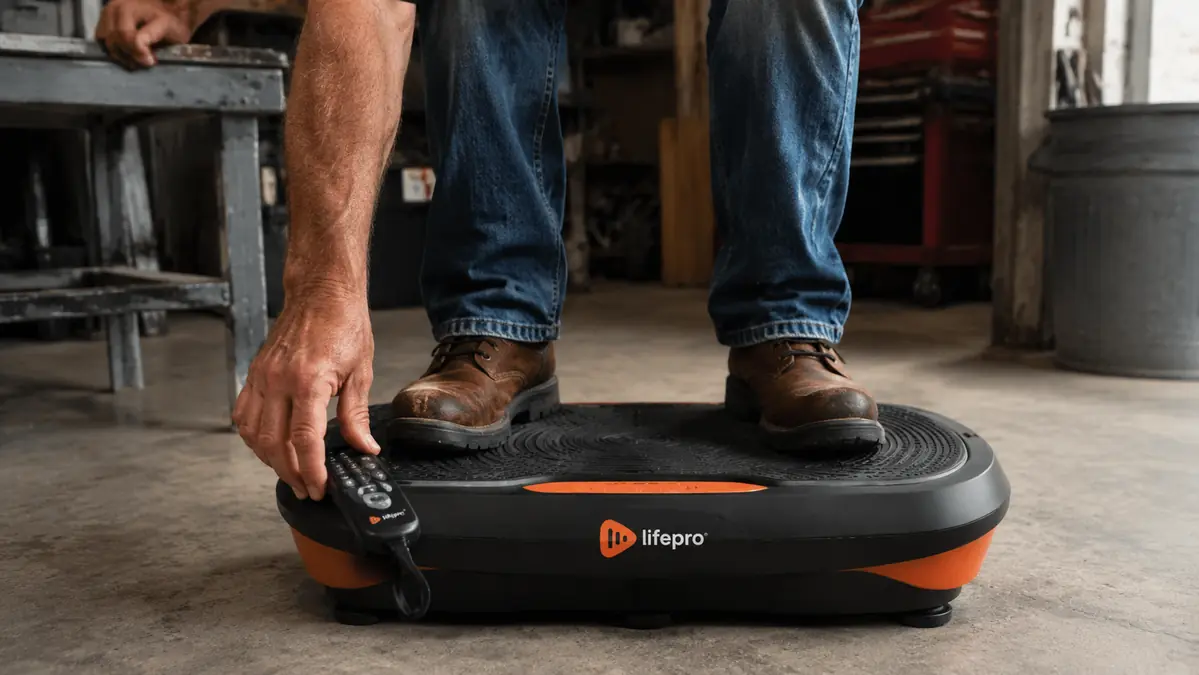
The Lifepro 4D Rumblex is the plate I use every evening, triple motor, 60 speed settings, and a wrist remote so I'm not bending over to adjust it after a long shift. Check today's price and rating on Amazon before your first session.
Amazon Check Today's Price on Amazon →Step 1: Warm up your stance before you turn anything on
The first thing I got wrong was standing dead center on the plate with my legs locked straight, like I was posing for a photo. That's the wrong way to start. Feet should be shoulder-width apart, knees soft with a slight bend, weight evenly split between both feet. Locked knees just transmit the vibration straight up into your joints instead of letting your legs absorb it, and that's not what you want after a day that's already been hard on your knees.
I spend the first thirty seconds just standing there getting my footing right before I even touch the remote. It sounds like nothing, but that thirty seconds is the difference between a session that leaves my knees feeling fine and one where I notice them the next morning. Get the stance right first, every time, even on the days I want to rush through it because dinner's getting cold.
The handrail on the front of the unit isn't just for balance when you're getting on and off. Early on I'll rest a hand on it lightly while I get used to the plate moving under me, especially if I've had a beer or two and my balance isn't at its sharpest. There's no shame in holding on. The point is getting blood moving, not proving something.
Step 2: Start low and let the speed climb over the session
This unit has 60 speed settings and seven presets, and the mistake I made the first week was cranking it up to see what it could do. That's backwards. I start every session on one of the lowest settings, somewhere in the 5 to 8 range, for the first two minutes. That's enough to get circulation moving without rattling my fillings loose.
After those first two minutes I'll bump it up into the middle range, 20 to 30, for the bulk of the session. That's where I actually feel the muscles in my calves and thighs working a little, not just vibrating along for the ride. My whole session runs about ten minutes total, and I've never needed to go above 35 or so to feel it doing something real for circulation purposes.
The remote makes this easy, I can bump the speed up or down without crouching down to the base unit, which matters more than it sounds like when your lower back is already tired from a day of bending over an engine bay. Small thing, but it's the kind of small thing that decides whether I actually use a piece of equipment or let it collect dust in the corner of the garage.
I tried a couple of the built-in presets when I first got the plate, mostly out of curiosity, and I'll be honest, most of them are tuned more for a workout feel than a circulation feel. I keep coming back to manual speed control instead, dialing it myself based on how heavy my legs feel that particular evening. A slow Monday standing around the shop waiting on parts is a different session than a Friday spent under three trucks in a row, and the presets don't know the difference. I do.
Step 3: Hold simple positions instead of trying to exercise on it
For pure circulation work, I'm not doing squats or lunges on this thing, that's a different use case entirely. I'm holding basic positions and letting the plate do the work. A minute standing flat-footed, a minute with my weight shifted slightly onto my toes, a minute with a slight knee bend like I'm about to sit in a chair. Each position moves the vibration through a slightly different part of my lower leg.
Sometimes I'll sit on a low stool with just my feet on the plate instead of standing at all, especially on nights when my lower back is the thing that's shot, not my legs. That still gets circulation moving through the calves and feet without asking my back to hold me upright the whole time. It's a smaller effect than standing, but on a bad back night it's better than skipping the session entirely.
I've also started resting my hands on my thighs and just letting my arms hang loose on the plate a couple times a week, more for the forearms and hands after gripping tools all day than for leg circulation. It's not the main use case for this machine, but the vibration through the whole body does seem to loosen up stiff hands better than nothing.
The biggest mistake I see guys make once they get comfortable on the plate is turning it into a full leg workout, calf raises, squats, the whole routine, every single night. That's fine on a day your legs feel fresh, but on a day they're already fried from standing, adding more load defeats the point. Some evenings the right move is standing still and letting the vibration do the work, not asking your legs to perform on top of everything else they already did that day.

Step 4: Watch how your legs actually respond, not the clock
The signal I'm looking for is warmth. Somewhere around the four or five minute mark, my calves start to feel warm in a way they don't from just sitting around, almost like after a light jog but without the impact on my knees. That warmth is blood moving through tissue that's been sluggish all day, and it's the reason I keep doing this instead of just propping my feet up on the couch.
If I don't feel that warmth by around minute six, I'll bump the speed up a notch rather than just running out the clock. And if my feet start going numb or tingly in a way that feels wrong, not just the normal buzzing sensation from the vibration, I get off the plate. That's happened maybe twice in months of use, and both times it was because I had bad shoes on that were already cutting off circulation before I even stepped on the machine.
Barefoot or thin socks works best for me, feeling what's actually happening under my feet instead of a thick boot sole dampening everything. I keep a pair of shop socks by the garage door specifically for this, so I'm not tracking concrete dust across the house on the way to my session.
I've timed sessions both right after work and later in the evening after dinner, and for circulation specifically, right when I walk in the door works better for me. That's when my legs are at their worst, and getting blood moving before I sit down to eat keeps the swelling from setting in the way it does if I let myself collapse on the couch first and try the plate two hours later.
Step 5: Cool down and stay off your feet for a few minutes after
The last thirty seconds of every session I drop the speed back down to where I started, low and easy, instead of just hitting the power button while I'm still at a middle setting. It's a small thing but it lets my legs come off the plate feeling settled instead of still buzzing when I walk away.
After I step off, I sit down for a couple minutes before I go back to being on my feet for the evening. There's usually a noticeable rush of warmth in my calves right after, similar to what BFR training gives me but without the bands, and I've learned to let that settle instead of immediately walking around the kitchen and losing the effect.
I run this most evenings, five or six nights a week, right when I get home from the shop before I even change out of my work clothes. It's become the transition point between work-mode and home-mode for me, ten minutes that tells my body the standing part of the day is over even though my legs don't always believe it right away.
What Else Helps
The plate isn't the whole answer by itself. I switched to real work boots with actual arch support a couple years back, and that alone did more for my circulation than I expected before I ever bought this machine. Cheap boots were part of the problem the whole time, I just didn't know it. Elevating my feet for ten minutes while I eat dinner has become part of the routine too, nothing fancy, just a stack of pillows on the ottoman.
Water intake matters more than people want to admit. I used to run on coffee and whatever was in the shop fridge, and my legs paid for it. Drinking enough through the day, not just at night, keeps blood thinner and moving the way it's supposed to. Walking my two huskies, Deacon and Luna, most evenings does the same job in a different way, actual movement instead of vibration, and the two things together do more than either one alone.
I also stopped standing flat-footed and locked up for long stretches at the bench, which I used to do without thinking about it. Now I shift my weight, rock heel to toe, take a lap around the shop every hour or so if a job lets me. That's free, doesn't need a machine, and it's probably done as much for my legs over the long run as any single piece of equipment sitting in my garage.
The plate doesn't fix a bad pair of boots or a day you never sat down. It just gets blood moving again after everything else already worked against it.
Ten minutes when you get home is all this routine takes.
If your legs feel heavy and swollen by the end of a shift, the Lifepro 4D Rumblex is the machine I'd point a buddy toward first. Check today's price on Amazon and see the current rating for yourself.
Amazon Check Today's Price on Amazon →